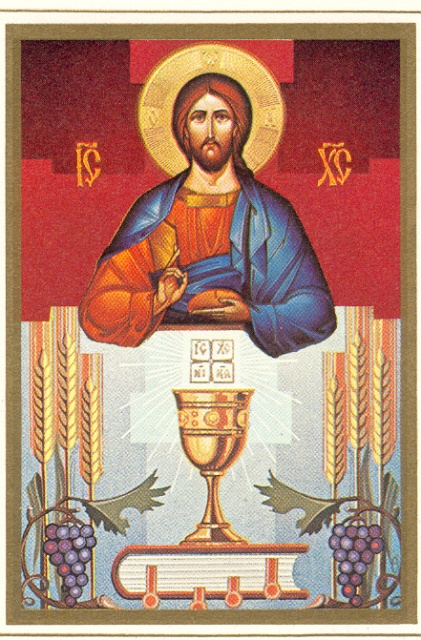
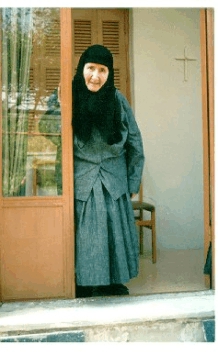
This is a paper written by an Orthodox Christian monk and priest as he contemplates his Alzheimer's disease. He has had the illness for four years more or less. It is a triumph of faith and hope and of love.
"This is a copy of a message I sent to good friends here who were inquiring about the status of my Alzheimer's Disease and were wondering if it is even even appropriate to ask. After I wrote it I though I would share it with you and a few others, and you may share it with anyone you think might also be interested. Here is the message, below:
It's quite all right for you to ask. I am very open about my illness, as is Gerondissa, and we do not hide anything or keep any secrets. And I have very little false pride about my limitations any more--I've already been through "that phase" and have been able to embrace my disease in the shadow of the Cross. More than that, I have begun the slow process of climbing up onto the Cross with our Lord, and sharing now in His Passion. This is incredibly sanctifying; I don't know how else to describe it. So although I don't talk much about my illness, it's not out of secrecy or pride or sensitivity, but only because I am keeping the Lord on the cross as close to my heart as I can. And He will get me through. It has frankly become as much a spiritual experience as a mental one.
So, I want to take this opportunity to share with you and Bruce, since we haven't really talked about it much. I have discussed it on several occasions with Dewayne and Janet, and they are wonderfully and appropriately sympathetic and helpful. They are more than relatives; they are good friends. I will talk more about it with my other siblings when we have a family reunion this summer. My children are completely on the same page with me already, but for them it is too painful to talk about much.
This illness is the oddest feeling of being somehow detached and experiencing a slow metamorphosis from being one person into another; not dramatic, but disconnected, and yet still able to pray, read, do email, recognize others (although my short term memory and my malapropisms have gotten worse over the last week). But at the same time it's oddly not depressing. (I went through the depressing stage last year.) In fact, I woke up this morning with Shadow having crawled up and curled into my left arm, and at the same time I had the most intense longing for heaven, which made me very happy.
The neurologist told me some time ago that there is a small percentage of AD victims who in some way consciously "know," all the way through, what is happening to them, and he thinks I am one of them. I don't know if that's a blessing or not, but I do think it's a blessing that I can share with others the various stages of this illness as long as possible. That sharing is helpful to me, and perhaps for others if they see that there is a spiritual way to "do" something that is otherwise so awful.
As you and Bruce know, Alzheimer's is a long and slow process, for which reason it's called "the long goodbye." But I read Patty Davis' fine book about her father, President Reagan, "The Long Goodbye," and she said that he remained cheerful, happy and polite as a three year old, right to the end. And I also know about the Alzheimer's of some great and holy Elders of our time, who were able to serve Liturgy and say the Jesus Prayer right to the end, even when they no longer recognized anyone else. So Alzheimer's doesn't have to be grueling and ugly, the way it is so often portrayed. I think that the perceived "terribleness" of this disease is at least in part a reflection of our incredibility morally and spiritually bankrupt culture.
With drugs and medical help, and very good care from Mother Beattifi , I have had three years of relatively slow deterioration, and I think that "slowness" will continue yet for some years. Right now is a different phase, though. I am very blessed to be in monastic life and here with Mother and the Fathers and Brothers just down the road, who also stay in contact and are very affectionately supportive. I feel safe and well cared for. There are many in my condition who cannot say that. Mother is a good friend, caretaker, intellectual and spiritual companion, but you and Tim will have to help her to harden her heart as time goes on and my symptoms become worse. I have already spoken to her about this, too. She is very tender-hearted and quietly suffers over my illness, although she's no drama-queen about it, as you can well believe. That's not her style. She only quietly says, "I don't like it," and that, coming from her, actually says a great deal.
From a purely spiritual standpoint I want to share with you the insight I believe God gave me from the time of my diagnosis. My greatest and overriding sin--indeed, even vice--has always been pride. Pride of mind, of "knowing better" and judging others inappropriately, sometimes thinking of them as being less than I am. This is a most grievous sin, and one that many people don't even recognize in themselves, but it is the one sin that will, above all, consign us to hell if we don't overcome it! It was the sin of Satan, the sin of Adam and Eve.
I understand fully how I got this way. I have throughout my life been inordinately proud of my mind, my intellect, my ability to think clearly about difficult and complicated things, to speak and write well, understand, process, and explain difficult things, etc. Growing up, I wasn't good at sports, I wasn't attractive to the ladies, I couldn't dance, I was an intellectual bookworm and loner, I had no other skill than my brain, and I used it and developed it as far as I possibly could, although actually I wasn't particularly academically brilliant, as all of that just seemed like some kind of superficial "game" to me. But that was my path in life. And although I have put these gifts to the service of Christ and the Church, as best I could, the pride has still been there.
Now the Lord has offered me a chance to mortify and humble down that pride, by accepting without complaint the slow crumbling of my mind. And I do accept this, with my whole heart, even if with the occasional tear, as a gift from Him for my salvation. So it sometimes "feels" as though this dying of various parts of my mind is also a dying of self, a dying of ego, a dying to pride. And isn't that the purpose of spiritual life, after all, anyway? The Lord looked down and saw that I wasn't going to do it any other way, and so, because He loves me very much (unworthy as I am) and wants me to be with Him forever, He offered me this incredible opportunity to die to self. I see this as a great, if sometimes painful, blessing!
Well, these are my few thoughts about it. Never hesitate to ask me how I'm doing. I will tell you honestly. But never feel sorry for me, or pity, as I do not for myself, but rather rejoice for me that I am on a sure path to the Kingdom of Heaven. I believe this with all my heart. --Fr. A"
Wednesday, January 20, 2010
Saturday, October 24, 2009
The Toss of a Coin
My young family was in a small Christian Group, hosted by the Rosencrkans family, a unit of the Evangel Temple Assembly of God in Springfield, Missouri. I had suggested one of two possible activities for the group to pursue. I was adamant and they acquiesced to a coin toss to decide which of the two activities we would pursue. We tossed the nickel into the air over the table, to decide the outcome. The nickel went up into the air and landed on the table, and it ..... balanced precisely on its edge and stood their, neither heads nor tails. It was met with gales of unbelief and laughter, putting me in my place and showing the great humor and intimacy of the Lord our God, the God of Abraham and Isaac, and of Jacob, resurrected in the person of our Lord, Savior and God Jesus Christ!
Wednesday, October 14, 2009
God is a Fly Fisherman- A BMW Story
Back in 1984 or 1985 I was a podiatrist in a new practice and quite poor and having trouble getting to my job and to my surgeries in my old Volvo. In frustration I prayed and complained to the Lord, "Lord, I have never had a new car, and I need a car to get to work."
I talked to my wife and she agreed that I needed reliable transportation. One day we were out driving and on impulse pulled into the first car dealership that we saw. It was a Chrysler, Mitsubishi, BMW dealership. Right away our eyes fell on a specific spiffy white 325 BMW. We were having fun so we took it for a test drive. We liked it. The interior lights were cool, it was tight and handled great, and the engine sounded like a jet fighter.
We liked the car. We also had no money, and our convictions made us believe that such a purchase flew in the face of Christian teaching on modesty and stewardship. So we said, 'thank you very much' to Ron, the car salesman, and left. However, we were very drawn to that car and it seemed to us that the Holy Spirit wanted us to get that car.
We thought we were imagnining things, so we went and looked at a practical car, a very nice Toyota Camry, also white. It was a great car but we felt a 'no', in our hearts. Well, fascinating. This went on for a few weeks and we went back and looked at the BMW again and still found the peculiar 'leading.'
We were going to a charismatic chuch and told a lady at the church about this particular adventure. The next week she came up to us and said, "I had a dream or a vision and I saw the initials B.M.W. in a column and they spelled out Ben Marston's Wheels." This was quite interesting and also raised the question- is this of God or from somewhere else? We had to test the spirit.
Finally, one day I went for a prayer walk at lunch as was often my custom and I told the Lord "OK, Lord, it seems you want us to have that BMW, and that specific model. But if you want us to have it, you will have to get it for us because we don't have any money."
I returned to the office and the postman had just come and left and in the mail was a letter informing us that a house that had been given to Mary in the passing of her parents had been sold and we were to receive enough money to cover the cost of the BMW plus some. Wow. We got the car.
In the process we struck up a friendship with Ron, the car salesman. Some time later he came in to my office as a patient. He was dying of an autoimmune disease that was destroying his kidneys. He also had a leg pain that he hoped I could help, and I managed to help him with anesthetic blocks to his common peroneal nerve that would last a period of time. It seemed to me that something spiritual was going on in his life, and so I invited him over to our house for a prayer meeting. Mary and I had an interesting way of cooperating in prayer meetings with the gifts of the Spirit working to inform us supernaturally and to empower the prayers.
We began praying for Ron, and he went unconscious and something took over him. Mary had been forewarned by the Lord and Mary bound a spirit that had put Ron in a martial arts position to take us out.
The thing then made him bend the knee at the name of Jesus.
We backed off and allowed Ron to 'surface.' We told him was was going on, and asked him if there was any sin that he needed to confess and we prayed for him and he remembered an instance on one of his four tours of duty in Viet Nam with special forces. He had killed a Russian advisor to the N. Vietnamese in Cambodia, and he had killed him by a knife stab to the right kidney.
Now that was very interesting. Ron, was dying of kidney failure and his right kidney was already at zero percent function. So we suggested that he repent in prayer for the killing. He did so and then we laid hands on him and began to pray for him. Mary saw the room fill up with angels, and Ron said somewhat the same and thought I had picked him up off the ground. It was quite an experience of the power of God.
After that Ron got better, and over the next several weeks his kidney function progressively restored being documented by the kidney function tests he took regularly.
Afterwards, Ron, who was still quite troubled by the horrors of special forces and four tours in Viet Nam, wound up in prison, but the combination of events eventually led him to surrender his life to Jesus and he became a quite sweet believer. He died at a young age.
A few years later Mary and I were becoming Orthodox and were learning to accept the communion of Saints. Mary and I were driving about on her birthday and suddenly it seemed like Ron was wishing her happy birthday in the spirit; I mentioned it to Mary and she said the same thing was happening to her.
Ron, from his vantage place in heaven, was helping us now along the Christian way. The BMW was a blessed car and saved me in the midst of an interstate wreck. Finally I had to sell it due to an economic reversal, and wound up with a black older car- just in time for our sojourn with the Mennonites who would have frowned at the extravagance of our spiffy, yuppie white BMW.
I talked to my wife and she agreed that I needed reliable transportation. One day we were out driving and on impulse pulled into the first car dealership that we saw. It was a Chrysler, Mitsubishi, BMW dealership. Right away our eyes fell on a specific spiffy white 325 BMW. We were having fun so we took it for a test drive. We liked it. The interior lights were cool, it was tight and handled great, and the engine sounded like a jet fighter.
We liked the car. We also had no money, and our convictions made us believe that such a purchase flew in the face of Christian teaching on modesty and stewardship. So we said, 'thank you very much' to Ron, the car salesman, and left. However, we were very drawn to that car and it seemed to us that the Holy Spirit wanted us to get that car.
We thought we were imagnining things, so we went and looked at a practical car, a very nice Toyota Camry, also white. It was a great car but we felt a 'no', in our hearts. Well, fascinating. This went on for a few weeks and we went back and looked at the BMW again and still found the peculiar 'leading.'
We were going to a charismatic chuch and told a lady at the church about this particular adventure. The next week she came up to us and said, "I had a dream or a vision and I saw the initials B.M.W. in a column and they spelled out Ben Marston's Wheels." This was quite interesting and also raised the question- is this of God or from somewhere else? We had to test the spirit.
Finally, one day I went for a prayer walk at lunch as was often my custom and I told the Lord "OK, Lord, it seems you want us to have that BMW, and that specific model. But if you want us to have it, you will have to get it for us because we don't have any money."
I returned to the office and the postman had just come and left and in the mail was a letter informing us that a house that had been given to Mary in the passing of her parents had been sold and we were to receive enough money to cover the cost of the BMW plus some. Wow. We got the car.
In the process we struck up a friendship with Ron, the car salesman. Some time later he came in to my office as a patient. He was dying of an autoimmune disease that was destroying his kidneys. He also had a leg pain that he hoped I could help, and I managed to help him with anesthetic blocks to his common peroneal nerve that would last a period of time. It seemed to me that something spiritual was going on in his life, and so I invited him over to our house for a prayer meeting. Mary and I had an interesting way of cooperating in prayer meetings with the gifts of the Spirit working to inform us supernaturally and to empower the prayers.
We began praying for Ron, and he went unconscious and something took over him. Mary had been forewarned by the Lord and Mary bound a spirit that had put Ron in a martial arts position to take us out.
The thing then made him bend the knee at the name of Jesus.
We backed off and allowed Ron to 'surface.' We told him was was going on, and asked him if there was any sin that he needed to confess and we prayed for him and he remembered an instance on one of his four tours of duty in Viet Nam with special forces. He had killed a Russian advisor to the N. Vietnamese in Cambodia, and he had killed him by a knife stab to the right kidney.
Now that was very interesting. Ron, was dying of kidney failure and his right kidney was already at zero percent function. So we suggested that he repent in prayer for the killing. He did so and then we laid hands on him and began to pray for him. Mary saw the room fill up with angels, and Ron said somewhat the same and thought I had picked him up off the ground. It was quite an experience of the power of God.
After that Ron got better, and over the next several weeks his kidney function progressively restored being documented by the kidney function tests he took regularly.
Afterwards, Ron, who was still quite troubled by the horrors of special forces and four tours in Viet Nam, wound up in prison, but the combination of events eventually led him to surrender his life to Jesus and he became a quite sweet believer. He died at a young age.
A few years later Mary and I were becoming Orthodox and were learning to accept the communion of Saints. Mary and I were driving about on her birthday and suddenly it seemed like Ron was wishing her happy birthday in the spirit; I mentioned it to Mary and she said the same thing was happening to her.
Ron, from his vantage place in heaven, was helping us now along the Christian way. The BMW was a blessed car and saved me in the midst of an interstate wreck. Finally I had to sell it due to an economic reversal, and wound up with a black older car- just in time for our sojourn with the Mennonites who would have frowned at the extravagance of our spiffy, yuppie white BMW.
Friday, October 9, 2009
The Communion of Saints- Profoundly Scriptural
Hebrews 12 is the Scriptural basis of the Communion of Saints. What do I mean by the Communion of Saints?
The term is from the Apostles' Creed, a Creed confessed by many bodies of Christians. The communion of Saints is the mystical spiritual reality that in Christ there is a fellowship within the Church between those in heaven and those on earth and transcends the limits that were hitherto imposed by death before the Victory of Christ, with his death, the harrowing of hell, his resurrection and asencsion. In the Communion of Saints, we pray to Christ, and ask the prayers of those whose victory in Christ has been won. In the Communion of Saints, those in heaven follow the example of their head and make intercession for those on earth.
The doctrine of the Communion of Saints scares many Christians in the Protestant tradition, especially in the Evangelical quarter of that movement. It scares them because it does not to their way of thinking have Scriptural foundation. To many the invocation of Saints makes them think of the Old Testament prohibition against necromancy, mediumism, and brings to mind the mediumistic calling of of Samuel by the witch of Endor for King Saul in his time of abandonment by God.
It used to bother me too, and I once wrote a tract in which I expressed my feelings at the time that there was simply no need for the invocation of Saints because communion with the Lord was so fulfilling.
Along the way I became an Eastern Orthodox Christian and part of that is the acceptance of the doctrine of the Communion of Saints, and we do ask the Saints for prayer. On the way to Orthodoxy I had a number of interesting experiences that helped to re-shape my thinking, but the most helpful thing for others confronting this issue is to re-visit Scriptures that I think point clearly to the Practice as being firmly based on Scripture.
To see the Communion of Saints based squarely on Scripture one must have a certain viewpoint of Scripture. Scripture is not systematic theology. Most of the New Testament was written in order to fix things that were going wrong in the Churches that had already received the full Apostolic Tradition by the teaching of the Apostles- before any of it had been written down. So Scripture as we have it today was not written to be a complete treatment of the fullness of the Faith. However, Scripture is the supreme expression of the Faith and so the things that exist within Christian Faith and Practice must find concord in Scripture. However, there are things in the Christian Tradition that are not explicitly stated in Scripture. For example, we are never commanded to celebrate the Resurrection on the first day of the week. However, that was the universal practice of the Church from the beginning. Scripture itself tells us that we are to observe the written and oral traditions of the Apostles.
2Th 2:15 Therefore, brethren, stand fast, and hold the traditions which ye have been taught, whether by word, or our epistle
So, it is possible that a practice in the Church not be expressly commanded or exampled in Scripture yet be fully in accord with its teaching. This is the case of the Communion of Saints.
It is not expressly commanded or exampled in Scripture but it is fully in accord with It and is a valued part of the Apostolic Tradition.
The Old Testament did not give us any example of the Communion of Saints. The righteous dead reposed in the place of Abraham's bosom, which was a place that was not torment but it was separated from Paradise and a place of longing by all the righteous of the ages for full redemption promised by the Law and the Prophets. It took the formation of the Church as the Body of Christ to accomplish two things so as to make the Communion of Saints a reality. The victory of Christ in his death, resurrrection and asension populated Paradise once again with the righteous of all ages. And by virtue of the Union of all believers in Christ, whether on earth or in Paradise as members of His body, a communion was established in the Holy Spirit, that hitherto, did not exist, and was a totally new order of existence for human beings. This spiritual communion in Christ that comprised believers in heaven and on earth laid the conditions for a first fruit as it were, in anticipation of the Resurrection, the full restoration of all of Humanity in Christ. This first fruit was a spiritual communion that all believers, everywhere have in Christ-whether in heaven or in earth.
It says it in Scripture 'if we walk in the light as He is in the light, we have fellowship with one another.' I John 1:7
There is nothing in this that limits the fellowship to those on earth, and the Church is one body, both in paradise and on earth. Further, it is a fellowship where one member cannot say of the other, "I have no need of you." , which is the theme of I Corinthians the 12th and 14th chapters, concerning spiritual gifts. This applies not only to the brother standing in the Nave of the Church across from you but also to the brother, now sainted, standing in the heavenly throne room. You have need of him and those reposed in Christ awaiting the General Judgment have need of us. The Scrpture says as much. The foundation of the Church is the Apostles and the Prophets- not 'was' the foundation. Is the foundation.
There is a mutuality of dependence that exists across the gulf, uniting the Church militant and the Church triumphant. This dependence is explicit in Scripture. Jesus Christ the man, ever lives to intercede for us. Christ is the example for all those in Him in heaven to follow. Do you think that Christ is ever living to intercede for us, and those who follow Him, their captain, their elder brother, their Savior and their God, do not? No, those in heaven, who see Him as He is, are like Him, having been made more fully than we can possibly imagine, partakers of the Divine Nature. As Christ intercedes for us, soalso do the Saints who follow Him. Sure, his mediations are unique for He is the only mediator between God and man, according to nature- for He by His one Person united forever both to the Divine Nature and to the Human. By His unique existence He is the only mediator between God and man. However, according to grace, there are many who participate in his intercessions, who participate in his mediations, not according to nature, but according to grace.
Hebrews 12 is the clincher. In Hebrews 12 we must realize that we do not have an academic discourse here being delivered from a parchment that fell from heaven, telling Paul what it was like up there in heaven. No. When Paul was writing Hebrews 12 he was describing his experience of heavenly realities in Christ. Paul was opened to the heavenlies and experienced the reality of the union of heaven and earth that had been effected by the victory of Christ, and he saw that on the deep level of our being that those on earth were really united, not in a mere legal or positional way, but on the level of their inner being, on an ontological level, have their concourse in heaven.
"But ye are come unto mount Sion, and unto the city of the living God, the heavenly Jerusalem, and to an innumerable company of angels,23 To the general assembly and church of the firstborn, which are written in heaven, and to God the Judge of all, and to the spirits of just men made perfect,24 And to Jesus the mediator of the new covenant, and to the blood of sprinkling, that speaketh better things than that of Abel."
And
"Wherefore seeing we also are compassed about with so great a cloud of witnesses, let us lay aside every weight, and the sin which doth so easily beset us, "
Paul was not speaking metaphorically. He was speaking as the passage says concerning the Church, the called out; those assembled; for the Church is the fellowship of those, not just who have responded to the Gospel, but who, by virtue of the Gospel have been assembled in the heavenly assembly. We are called, of course, to fellowship with Jesus Christ on the basis of this
having been assembled in heaven. It is the basis for our ability to pray to Him and to be heard of Him and for us to have fellowship and Communion with Him. But, by the same token, we have also been gathered to the spirits of just men made perfect, that is to say, the Saints, with whom we have spiritual fellowship in the Holy Spirit, and the gathering together with their spirits is the very basis for the ancient and historic practice of the invocation of Saints. It's logic is the same of any prayer request addressed to anyone that we may see on earth who is an earnest believer. Its spiritual certainty has to do with the cosmic change introduced into the human family by the formation of the Church, the general assembly of the First Born- which is comprised of all believers whether still plodding the earth, or passed on into heavenlies, awaiting the General Resurrection. The Communion of Saints is perfectly grounded in the realities that Paul describes in Hebrews 12. In the light that we have been gathered to the Saints in heaven, not just in a positional or legal sense, but in a real and ontological sense, how can we not rather conclude that it would be impious to live out our Christian lives without asking for the prayers, not only of Christ, but also His friends, whom He has called to share in His ministry, to rule and reign with Him? No. The communion of Saints is demanded of us who believe Scripture and meditate on the full implications of the teaching in Hebrews 12.
Hebrews 12 also finds additional support from the letter of Paul to the Ephesians in the second chapter.
"But God, who is rich in mercy, for his great love wherewith he loved us,5 Even when we were dead in sins, hath quickened us together with Christ, (by grace ye are saved;)6 And hath raised us up together, and made us sit together in heavenly places in Christ Jesus:"
This passage is not simply a fancy way of saying we are saved, but it is pointing to the fundamental change that has happened in the cosmos by Jesus Christ in the Church which is His Body. We now have being, both in heaven and on earth. In Jesus Christ heaven and earth are once again united in Him, and by our participation in his life we participate in real heavenly concourse that begins now. Ephesians 2 is also a foundational passage that undergird the good and pious doctrine of the Communion of Saints.
For this reason, the doctrine of the Communion of Saints was included in what came to be known as the Apostles' Creed. It was the broad experience of the early Church there was a deep mystical sense of the communion of heaven and of earth. You see it in the account of the martyrdom of Polycarp in the early writings of the Church. You see it in the Catacombs of Rome where the early Christians asked in writing for the prayers of the departed. You find that it is the universal conviction of every one of the ancient Churches, whose traditions go back to the beginning, whether Orthodox, or Roman Catholic, or Egyptian Coptic, or Oriental Orthodox of Syria , India or Armenia.
The Communion of Saints relates to a larger view of salvation. Too often in individualistic America where we are focused on getting our individual souls 'saved', we fail to realize that salvation has a larger dimension, and that is the restoration of the Human family, in Christ, the recapitulation of the failed lineage of Adam, in the triumphant headship of Christ. It is not just saved souls that Christ was after but a restored Humanity. That is what the Communion of Saints points to- the larger dimension of salvation which was at the heart of Christ's program of salvation.
Of course, given the human penchant for missing the mark, there has been the abuse of the doctrine of Communion of Saints, superstitious applications of it, imbalance in the presentation of it, casual or flippant use of it. But such is the case with anything that people touch . Because of abuses we should not throw the baby out with the bathwater.
This paper I am writing on the 11th of October, which is the Name Day of my Patron Saint. As I was becoming Orthodox, I wanted to enter into the Communion of Saints carefully and experientially. I did not want to speak about it simply out of a rote repitition of my catachesis. So, when it came time for me to take a patron saint, I prayed about it. I had been told, you don't pick the saints, they pick you. So, I prayed, "Ok, Lord, I am supposed to have a Patron Saint, so I ask you to lead me to one." "St. Philip", was immediately, inaudibly, and unexpectedly, implanted on my spirit.
Wow, interesting. I waited a few days, and said, that could be my imagination. I said, "Lord, how bout some confirmation." "Acts 8". Once again impressed on my spirit. I remembered St. Philip was in the book of Acts, but I did not remember the chapter. I went and looked up the eighth chapter, and there he was! Being sent to the heterodox Samaritans, working miracles, evangelizing, a first class deacon! That sealed it for me. St. Philip is my patron saint. My Orthodox name is Philip.
Several years earlier, when we were attending a 28 Prayer Book Anglican Church, that had a statue of the Virgin Mary, that made me feel very uncomfortable, we had one Sunday an especially precious Communion Service. The Lord was so very Present in the Bread and the Wine. And that special presence continued all day. That evening we were driving back from fellowship with our friends the Desroches, and while the family was asleep and I was driving, there came to my attention in that afterglow of the Lord's presence, a presence within His presence, a feminine presence- and I knew that it was His Mother. That happened and I left it on the shelf for another five years, because at the time, I had no way of handling that experience doctrinally. I knew is was not a demon; I had had extensive experience in deliverance work, and I knew it was not the enemy. It took me several years of prayer to come to terms with that experience. Since that time, there have been times when I have asked Her for prayers, and have had the most precious answers to the glory of God. What can I say? She is His mother; and I love her. She is a most precious part of the communion of Saints. Blessed is the word.
Then there was the time that I woke up one night. "I'm ok", I heard in my spirit, and I knew that it was my dear elder friend Pastor Will the Lutheran. I woke Mary up and told her. The next day Mary called me and said, "Pastor Will passed away just about the time that you had that experience. That was the communion of Saints.
Then there was the time after I had lost my podiatry license and was unemployed because of a fight with the IRS. I went to a monastery for a retreat, happened to pick up some literature, that introduced me to a Gr. Gavrilia, and I was just stunned because she was a podiatrist who quit her podiatry at age 56 and was called to other things; the same age that I was when I ceased being a podiatrist. She became one of my favorite heavenly prayer partners, one who is keenly identified with my current adventures in life.
So, to my reading of Scripture, and to my experience in Christ, the Communion of Saints is a doctrine most agreeable, and a practice most wholesome and necessary as a part of the great salvation that has come to us through our Lord, Savior and God Jesus Christ, who with His Unoriginate Father, and All holy and good and life-giving Spirit, alone is worshipped and glorified. Amen.
The term is from the Apostles' Creed, a Creed confessed by many bodies of Christians. The communion of Saints is the mystical spiritual reality that in Christ there is a fellowship within the Church between those in heaven and those on earth and transcends the limits that were hitherto imposed by death before the Victory of Christ, with his death, the harrowing of hell, his resurrection and asencsion. In the Communion of Saints, we pray to Christ, and ask the prayers of those whose victory in Christ has been won. In the Communion of Saints, those in heaven follow the example of their head and make intercession for those on earth.
The doctrine of the Communion of Saints scares many Christians in the Protestant tradition, especially in the Evangelical quarter of that movement. It scares them because it does not to their way of thinking have Scriptural foundation. To many the invocation of Saints makes them think of the Old Testament prohibition against necromancy, mediumism, and brings to mind the mediumistic calling of of Samuel by the witch of Endor for King Saul in his time of abandonment by God.
It used to bother me too, and I once wrote a tract in which I expressed my feelings at the time that there was simply no need for the invocation of Saints because communion with the Lord was so fulfilling.
Along the way I became an Eastern Orthodox Christian and part of that is the acceptance of the doctrine of the Communion of Saints, and we do ask the Saints for prayer. On the way to Orthodoxy I had a number of interesting experiences that helped to re-shape my thinking, but the most helpful thing for others confronting this issue is to re-visit Scriptures that I think point clearly to the Practice as being firmly based on Scripture.
To see the Communion of Saints based squarely on Scripture one must have a certain viewpoint of Scripture. Scripture is not systematic theology. Most of the New Testament was written in order to fix things that were going wrong in the Churches that had already received the full Apostolic Tradition by the teaching of the Apostles- before any of it had been written down. So Scripture as we have it today was not written to be a complete treatment of the fullness of the Faith. However, Scripture is the supreme expression of the Faith and so the things that exist within Christian Faith and Practice must find concord in Scripture. However, there are things in the Christian Tradition that are not explicitly stated in Scripture. For example, we are never commanded to celebrate the Resurrection on the first day of the week. However, that was the universal practice of the Church from the beginning. Scripture itself tells us that we are to observe the written and oral traditions of the Apostles.
2Th 2:15 Therefore, brethren, stand fast, and hold the traditions which ye have been taught, whether by word, or our epistle
So, it is possible that a practice in the Church not be expressly commanded or exampled in Scripture yet be fully in accord with its teaching. This is the case of the Communion of Saints.
It is not expressly commanded or exampled in Scripture but it is fully in accord with It and is a valued part of the Apostolic Tradition.
The Old Testament did not give us any example of the Communion of Saints. The righteous dead reposed in the place of Abraham's bosom, which was a place that was not torment but it was separated from Paradise and a place of longing by all the righteous of the ages for full redemption promised by the Law and the Prophets. It took the formation of the Church as the Body of Christ to accomplish two things so as to make the Communion of Saints a reality. The victory of Christ in his death, resurrrection and asension populated Paradise once again with the righteous of all ages. And by virtue of the Union of all believers in Christ, whether on earth or in Paradise as members of His body, a communion was established in the Holy Spirit, that hitherto, did not exist, and was a totally new order of existence for human beings. This spiritual communion in Christ that comprised believers in heaven and on earth laid the conditions for a first fruit as it were, in anticipation of the Resurrection, the full restoration of all of Humanity in Christ. This first fruit was a spiritual communion that all believers, everywhere have in Christ-whether in heaven or in earth.
It says it in Scripture 'if we walk in the light as He is in the light, we have fellowship with one another.' I John 1:7
There is nothing in this that limits the fellowship to those on earth, and the Church is one body, both in paradise and on earth. Further, it is a fellowship where one member cannot say of the other, "I have no need of you." , which is the theme of I Corinthians the 12th and 14th chapters, concerning spiritual gifts. This applies not only to the brother standing in the Nave of the Church across from you but also to the brother, now sainted, standing in the heavenly throne room. You have need of him and those reposed in Christ awaiting the General Judgment have need of us. The Scrpture says as much. The foundation of the Church is the Apostles and the Prophets- not 'was' the foundation. Is the foundation.
There is a mutuality of dependence that exists across the gulf, uniting the Church militant and the Church triumphant. This dependence is explicit in Scripture. Jesus Christ the man, ever lives to intercede for us. Christ is the example for all those in Him in heaven to follow. Do you think that Christ is ever living to intercede for us, and those who follow Him, their captain, their elder brother, their Savior and their God, do not? No, those in heaven, who see Him as He is, are like Him, having been made more fully than we can possibly imagine, partakers of the Divine Nature. As Christ intercedes for us, soalso do the Saints who follow Him. Sure, his mediations are unique for He is the only mediator between God and man, according to nature- for He by His one Person united forever both to the Divine Nature and to the Human. By His unique existence He is the only mediator between God and man. However, according to grace, there are many who participate in his intercessions, who participate in his mediations, not according to nature, but according to grace.
Hebrews 12 is the clincher. In Hebrews 12 we must realize that we do not have an academic discourse here being delivered from a parchment that fell from heaven, telling Paul what it was like up there in heaven. No. When Paul was writing Hebrews 12 he was describing his experience of heavenly realities in Christ. Paul was opened to the heavenlies and experienced the reality of the union of heaven and earth that had been effected by the victory of Christ, and he saw that on the deep level of our being that those on earth were really united, not in a mere legal or positional way, but on the level of their inner being, on an ontological level, have their concourse in heaven.
"But ye are come unto mount Sion, and unto the city of the living God, the heavenly Jerusalem, and to an innumerable company of angels,23 To the general assembly and church of the firstborn, which are written in heaven, and to God the Judge of all, and to the spirits of just men made perfect,24 And to Jesus the mediator of the new covenant, and to the blood of sprinkling, that speaketh better things than that of Abel."
And
"Wherefore seeing we also are compassed about with so great a cloud of witnesses, let us lay aside every weight, and the sin which doth so easily beset us, "
Paul was not speaking metaphorically. He was speaking as the passage says concerning the Church, the called out; those assembled; for the Church is the fellowship of those, not just who have responded to the Gospel, but who, by virtue of the Gospel have been assembled in the heavenly assembly. We are called, of course, to fellowship with Jesus Christ on the basis of this
having been assembled in heaven. It is the basis for our ability to pray to Him and to be heard of Him and for us to have fellowship and Communion with Him. But, by the same token, we have also been gathered to the spirits of just men made perfect, that is to say, the Saints, with whom we have spiritual fellowship in the Holy Spirit, and the gathering together with their spirits is the very basis for the ancient and historic practice of the invocation of Saints. It's logic is the same of any prayer request addressed to anyone that we may see on earth who is an earnest believer. Its spiritual certainty has to do with the cosmic change introduced into the human family by the formation of the Church, the general assembly of the First Born- which is comprised of all believers whether still plodding the earth, or passed on into heavenlies, awaiting the General Resurrection. The Communion of Saints is perfectly grounded in the realities that Paul describes in Hebrews 12. In the light that we have been gathered to the Saints in heaven, not just in a positional or legal sense, but in a real and ontological sense, how can we not rather conclude that it would be impious to live out our Christian lives without asking for the prayers, not only of Christ, but also His friends, whom He has called to share in His ministry, to rule and reign with Him? No. The communion of Saints is demanded of us who believe Scripture and meditate on the full implications of the teaching in Hebrews 12.
Hebrews 12 also finds additional support from the letter of Paul to the Ephesians in the second chapter.
"But God, who is rich in mercy, for his great love wherewith he loved us,5 Even when we were dead in sins, hath quickened us together with Christ, (by grace ye are saved;)6 And hath raised us up together, and made us sit together in heavenly places in Christ Jesus:"
This passage is not simply a fancy way of saying we are saved, but it is pointing to the fundamental change that has happened in the cosmos by Jesus Christ in the Church which is His Body. We now have being, both in heaven and on earth. In Jesus Christ heaven and earth are once again united in Him, and by our participation in his life we participate in real heavenly concourse that begins now. Ephesians 2 is also a foundational passage that undergird the good and pious doctrine of the Communion of Saints.
For this reason, the doctrine of the Communion of Saints was included in what came to be known as the Apostles' Creed. It was the broad experience of the early Church there was a deep mystical sense of the communion of heaven and of earth. You see it in the account of the martyrdom of Polycarp in the early writings of the Church. You see it in the Catacombs of Rome where the early Christians asked in writing for the prayers of the departed. You find that it is the universal conviction of every one of the ancient Churches, whose traditions go back to the beginning, whether Orthodox, or Roman Catholic, or Egyptian Coptic, or Oriental Orthodox of Syria , India or Armenia.
The Communion of Saints relates to a larger view of salvation. Too often in individualistic America where we are focused on getting our individual souls 'saved', we fail to realize that salvation has a larger dimension, and that is the restoration of the Human family, in Christ, the recapitulation of the failed lineage of Adam, in the triumphant headship of Christ. It is not just saved souls that Christ was after but a restored Humanity. That is what the Communion of Saints points to- the larger dimension of salvation which was at the heart of Christ's program of salvation.
Of course, given the human penchant for missing the mark, there has been the abuse of the doctrine of Communion of Saints, superstitious applications of it, imbalance in the presentation of it, casual or flippant use of it. But such is the case with anything that people touch . Because of abuses we should not throw the baby out with the bathwater.
This paper I am writing on the 11th of October, which is the Name Day of my Patron Saint. As I was becoming Orthodox, I wanted to enter into the Communion of Saints carefully and experientially. I did not want to speak about it simply out of a rote repitition of my catachesis. So, when it came time for me to take a patron saint, I prayed about it. I had been told, you don't pick the saints, they pick you. So, I prayed, "Ok, Lord, I am supposed to have a Patron Saint, so I ask you to lead me to one." "St. Philip", was immediately, inaudibly, and unexpectedly, implanted on my spirit.
Wow, interesting. I waited a few days, and said, that could be my imagination. I said, "Lord, how bout some confirmation." "Acts 8". Once again impressed on my spirit. I remembered St. Philip was in the book of Acts, but I did not remember the chapter. I went and looked up the eighth chapter, and there he was! Being sent to the heterodox Samaritans, working miracles, evangelizing, a first class deacon! That sealed it for me. St. Philip is my patron saint. My Orthodox name is Philip.
Several years earlier, when we were attending a 28 Prayer Book Anglican Church, that had a statue of the Virgin Mary, that made me feel very uncomfortable, we had one Sunday an especially precious Communion Service. The Lord was so very Present in the Bread and the Wine. And that special presence continued all day. That evening we were driving back from fellowship with our friends the Desroches, and while the family was asleep and I was driving, there came to my attention in that afterglow of the Lord's presence, a presence within His presence, a feminine presence- and I knew that it was His Mother. That happened and I left it on the shelf for another five years, because at the time, I had no way of handling that experience doctrinally. I knew is was not a demon; I had had extensive experience in deliverance work, and I knew it was not the enemy. It took me several years of prayer to come to terms with that experience. Since that time, there have been times when I have asked Her for prayers, and have had the most precious answers to the glory of God. What can I say? She is His mother; and I love her. She is a most precious part of the communion of Saints. Blessed is the word.
Then there was the time that I woke up one night. "I'm ok", I heard in my spirit, and I knew that it was my dear elder friend Pastor Will the Lutheran. I woke Mary up and told her. The next day Mary called me and said, "Pastor Will passed away just about the time that you had that experience. That was the communion of Saints.
Then there was the time after I had lost my podiatry license and was unemployed because of a fight with the IRS. I went to a monastery for a retreat, happened to pick up some literature, that introduced me to a Gr. Gavrilia, and I was just stunned because she was a podiatrist who quit her podiatry at age 56 and was called to other things; the same age that I was when I ceased being a podiatrist. She became one of my favorite heavenly prayer partners, one who is keenly identified with my current adventures in life.
So, to my reading of Scripture, and to my experience in Christ, the Communion of Saints is a doctrine most agreeable, and a practice most wholesome and necessary as a part of the great salvation that has come to us through our Lord, Savior and God Jesus Christ, who with His Unoriginate Father, and All holy and good and life-giving Spirit, alone is worshipped and glorified. Amen.
Saturday, September 26, 2009
Shema
Have you read Francis Schaeffer? Well, back in the seventies I was very interested in what he wrote. There was one thing he pointed out to me that stuck. He said, "If the God of the Christians did not exist in Trinity, I would still be an unbeliever."
He explained that his conviction was based on the idea of God as love. God is love; God is also free under no compulsion, nor any necessity to do or think or behave in any way. Because God is love, if He did not exist as multiple persons in one Godhead, then for God to be able to love, He would be under 'necessity' to create a creature to be the object of His love. The idea that God is free would be sullied. It is therefore 'necessary' that God exist as more than one person in order that He be free. Of course to use the word 'necessary' with respect to God is in itself fraought with difficulty.
Later, in reading St. Pavel Florensky, martyr of the Boshevik era, it came to me why God would of 'necessity' need to be a Triad rather than a Dyad. If God existed as two persons, say Father and Son, then he would have the Son to love, but He would not be in principle free to chose the Son to love. He would only have the Son as His object of love. however, with the Three, The Father not only has another to love, but is, in principle free to love the other or not because he always has the choice of the third where his love may be expressed.
More digressions on the Trinity. Another foundational principle of the Godhead driven home principally in Orthodoxy is that the distance between God and the Creature is infinite, so that if a man can conceive of God as He is according to His inner being, His essence, then it is not God at all but a creation of human thought and reason, a part of creation, an idol. The idea of the Trinity cannot be understand with reason or human thought, for the idea of the Trinity is 3=1, something we cannot comprehend. It is an antinomy. If we have a God who can be explained in his inner being in rational terms, He is not the God of Abraham and Isaac and Jacob and Paul and Peter, and Pavel Florensky- but is the God of our own imaginings, the God of the philosophers and not the God who is God. Vladimir Lossky makes this point in his fantastic book, The Mystical Theology of the Eastern Church.
Some of Judaic orientation may remember the Shema, " the Lord thy God is One God", but the Hebrew word for One in this case, 'echod', means a composite unity ( see: http://www.thoughts.com/journeyman/blog/the-mystery-of-the-trinity-49247/ , and http://www.thoughts.com/journeyman/blog/the-mystery-of-the-trinity-49247/ , and http://www.thoughts.com/journeyman/blog/the-mystery-of-the-trinity-49247/ ) The idea of God as Trinity began in the Old Testament, but was not fully revealed until the New, in the Baptism of Christ. As the troparion goes, "When Christ was baptized in the Jordan the worship of the Trinity was made manifest."
Another way of saying this is that God in His transcendence exists in infinite distance from the creature. And this brings us to another antinomy concerning the Godhead, that is chiefly in a repository of the Orthodox East. While God is utterly unknowable in His Essence , He is profoundly knowable in His Energies. The Energies of God being defined as the existence of God truly as Himself but outside of His Essence.
This is a distinction critical to thinking Christianity, if we wish to avoid all sorts of theological errors. So here we have an antinomy- God is not knowable and God is knowable. How both could be we have not a clue. Here again is an antinomy that exists in the nature of the Godhead and for me, is an ,aha, moment- here is the God who is beyond all thought and sense experience , for the only way to talk about him is through the mystery of antinomy. Here is the Gospel of the Cross, calling for us to die to our reasoning brain as we move beyond the cosmos that we can comprehend towards union with Him whom we cannot.
At the high level of Western theology, the mark of this has been missed, principally because the West, Catholic and Protestant, begin in their Theology with the Unity of the Godhead in the One Essence common to all three of the Persons. the unity is then an impersonal absolute, not really much different from Buddhism or Unitarianism and certainly within the realm of the thinking of philosophers and not the God of the antinomies, beyond all thought and sense experience. This tendency reduces the three persons of the Trinity into modes or expressions of the One Essence, and the relationships between them become one of the categories of Aristotelean logic, that of relationship, and so become subject to philosophical manipluations, and, once again, is not the God Who Is. Scripture and the Orthodox East preserve the Unity of the Godhead in the Father, who is the source both of the Son and of the Spirit, both without beginning, and also of the Essence which is imparted to the Son and the Spirit as well. The modes of generation of the Son and the Spirit, begetting and proceeding are not relationships but simply indicate their being distinct persons. what begetting is and proceeding is, is not know. It exists in mystery. So, the Father who is the Source, is the source of the Unity. The Unity is Personal. And our calling then is to participate in the Communion of love that Exists between Father and Son and Holy Spirit.
Consequently our prayer life and our experience must be that of the Trinity in some way. The experience of God is possible because, while He is unknowable in His Essence, He is knowable in His Energies and assimilable- the Energies being the same thing as Grace, or Divine Enabling,and also being that aspect of Divine Nature, spoken of by the Apostle Peter in his epistle as that of which we must become 'partakers'. The economic mode of the Trinity, how God in His Divine Energies, comes to us, is that the Spirit manifests the Son, who in turn shows us the Father. (Economia, in the East, is talk about God in His Theophanies or manifestations; whereas Theologia, is the thought about Him concerning His Essence)
This means that our prayer experience to be fully Christian must also be an experience of the Trinity. When Jesus was baptized in the Jordan, the Orthodox song goes, the worship of the Trinity was manifest.
When we first are drawn by the Gospel, we see Jesus, in all his incarnate glory, and then we see His passion, his death, resurrection and ascension. And If we get it, we get a personal relationship to Jesus, enabled by the Spirit. Road to Emmaus. But a funny thing happens after forty days. Christ ascends to the Father. For us who have been baptized into Christ, this returning to the Father, must become in prayer an existential reality. For the Son is always returning to the Father, and in Him it is His purpose for us to return to the Father as well. Well, a return to the Father is a return towards the Essential existence of the Father and Son and Holy Spirit, and the practical consequence is that such a return is a return into a 'Stillness.' the Son is ever taking us back to the Stillness of the Father. And there we have some classical mystics camping out- The Unknowing- and so forth, of a few. Also the comment by St. Ignatius the Godbearer in the First century, "those who have truly acquired the word of Jesus must go on to know His stillness so as to be perfect."
This is the "Be Still" of the Psalms. It is the Secret Place of the Most High. There are 'places' in the Most High that we experience before entering the Stillness, but They are the experiences of His energies- of the release of forgiven sins, of comforts in distress, of consolations, of feelings of love and Divine Providences. But the Stillness is an all together different place.
Since the Stillness is Beyond Word it is also beyond the experience of most who must have everything spelled out in detail in Scripture; it does not lend itself easily to words, and so usually exists within the Tradition of the Ancient churches- chiefly within the monastic Traditions. the Coptics have it. The Catholics sort of have it, in a distorted way, but it is there with some problems. the Orthodox have it. Yet Scripture itself calls us to obey the Traditions whether by Word or by Epistle. And point out that the Church is the pillar and ground of the Truth. In fact, Christ never promised a New Canon upon which to base anything. He promised a Church, and an indefectible Church because it was to be His Body. It's inerrance, therefore was not because there was a Book over it to keep it in check, nor a Pope over it to keep it in check, but a Holy Spirit within it to keep it in all the Truth and a Communion with the Blood of Christ that would keep it within the Truth- The Church would be kept by Communion with the Life of God. Since the Truth is a Person, the Incarnate One, His Body is the only acceptable locus where all the Fullness of Truth exist and be preserved.
So the Tradition of the Stillness that is a vital part of Christian prayer and experience is an open secret that is preserved amongst those dedicated chiefly to practicing it- the monks. Therefore, for me it is a great tragedy when any Christian Body does not have monks, engaged full time in prayer. Luther rejected the monks and if you have ever been around Lutherans, or studied their history, it is so terribly obvious. In the 19th Century there was only one pastor who excelled in the mystical life, Blumhardt was his name, if I remember correctly. And in reaction to German scholasticism, head religion, emerged pietism, as a reaction to dead Church life, which morphed later into revivalism and into evangelicalism of the mid Twentieth Century and now is find another metamorphosis in the spiritual formation movement which is a reformation of evangelical piestism, never find its proper incarnation in the life of a Church whose very mode of being nurtures the mystical and gives it objective boundaries, and shapes properly the mind of those who yearn for the mystical depths, so that their seekings and explorations do not go astray but return to the ever-renewing life of the Trinity.
Then these thoughts. The 'problem' in the Catholic West as far as communicating about its msyticism exist because the scholasticism of St. Thomas who continued to insist along with St. Augustine that grace was a creature, thereby removing from us the very possibility of the experience of God. In, in addition to that, he shifted the organ of revelation to the intelligence, the thinking aspects of the brain, rather than the "Orthodox" nous, the eye of the heart, bringing theology down into the domain of philosophy,rather than those things written by those who pray. Although they talk about their experience it is a distinct thought world from their theologizing so it seems to me. And as the evangelicals import spiritual techologies into their Chritianity, chiefly from the mystical Traditions of the West, they will eventually come up short attempting to explain what is going on, and there will be the inevitable conflicts as those with pockets of Orthodox doctrine collide with those who are following their experience and without the words or tradition that make the two a whole. So, I see, for example, conflicts on the ACU Facebook page, people decrying the wholesale capitulation of ACU to the Spiritual Formation movement and resorting to 'lighthouse trails' sort of materials to rebut the tendency. Lord have mercy.
The whole problem is the problem of trying to transplant one Organ of the ancient Church into a body that is not complementary to it. It is, in fact, the whole problem of the tribulation of Western Christianity. The Incarnational nature of the Church was forever lost at the time of the Great Schism/Reformation event and everhereafter exists in a paroxysm of agony suspended from an over-active reasoning brain, and a lost wandering nous seeking somewhere to land. Lord, have mercy
Labels:
3=1,
Dallas Willard and spiritual formation,
Shema,
Stillness,
Trinity
Monday, September 21, 2009
Hesychasm for Laymen
Metropolitan Jonah recently delivered a message on spiritual growth to our Diocese. He is not only our Metropolitan but locum tenans of the South, and that is us. In the message he underscored that the spirituality of Hesychasm, is at the heart of the Orthodox method of spiritual growth, and within or related to hesychasm was the pursuit of unceasing prayer, and particularly aided by the Jesus Prayer. So, in the Orthodox Method, we have hesychasm, the pursuit of unceasing prayer, and the Jesus Prayer.
As I read the offerings of Orthodox on the internet, I find almost nothing of practical value on the practice of hesychasm for laymen. We read about the hesychasm of the monks and the ascetics, but not much of the layman and it seems like it is almost a territory that we laymen are not able to enter.
Yet I would like to suggest that the Holy Spirit also works with laymen in the pursuit of hesychasm, which is not the pursuit of stillness for itself , but as a means of becoming participants in the Divine Nature. Hesychasm means Stillness, and what stillness has to do with the pursuit of God is especially difficult for Western Christian expecially since we tend to be so fixed on doing things to advance the Kingdom over Being certain sort of people. And as Laymen we are busy in the world having families and jobs and being involved in bunches of activities that keep us- busy.
However, the faith is one faith. There is not the faith for monks and the faith for laymen. It is all one faith. Monks are specialists is it true and it is their special calling that keeps alive the vision of prayer and of hesychasm itself. We would be lost without them. Churches that have lost monasticism or have had it sullied by modern trends of social gospel and activism to replace the life of prayer, have suffered an incalculable loss, for it is the monks that have kept the high tradition of prayer, and of stillness alive as a witness to us who do not have the calling or luxury of monastic poverty and givenness to prayer.
So, the Holy Spirit is working in our midst, if we will but listen to the word of Jesus; He is working to call us to hesychasm, to Stillness. The Hesychast interprets Christ's injunction in the Gospel of Matthew to "go into your closet to pray," to mean that he should ignore the senses and withdraw inward. St John of Sinai writes: "Hesychasm is the enclosing of the bodiless mind (nous) in the bodily house of the body." (Ladder, Step 27, 5, (Step 27, 6 in the Holy Transfiguration edition).) {quoted from http://www.newworldencyclopedia.org/entry/Hesychasm } But what is it exactly that we are being called to? The human personality is deranged by its fall into sin, and as participants in Adam's fall we suffer from this derangement. On the level of man's psychology the nous of man has lost its primordial focus on the vision of God and has changed its gaze outward into the senses and the thoughts. Man's nous has been cut off from the Stillness that is the Presence of the Father, and that ought to reside as the Secret Place within each man's heart and be the residing place of each man's nous or spiritual attention or spiritual focus or spiritual eye.
The nous then as the eye of the heart has lost the vision of God and needs to find its way back. Classical outlines of the spiritual life speak of purgation, illumination and Theosis as the steps back into full union with God. The call of hesychasm is an aspect of that and involves the weaning of the attention off things that are sinful, of course, but also things of the world that are not evil, in and of themselves, but are distractions to the real call of our nous and the source of a fundamental derangement and dis-integration of the human personality. This aspect of hesychasm is outward or bodily hesychasm for it does not yet reach in a conscious way the inner sanctum of the heart, an experience that comes as a consequence of and subsequent to the practice of bodily hesychams. Outward hesychasm finds its fruition in the eventual descent of the nous into the heart, which is recognized by the experience of a deep inner Stillness that one has not experienced before, no matter how zealous a Christian. One may have experience great relief and peace through forgiveness of sins, and great joy at the Providences of God, and been astute in the perception of the voice of Jesus and the leadings of the Spirit, but those are not the same thing. As St. Ignatius the God-bearer said, 'those who have really acquired the word of Jesus must go on to know His Stillness so as to be perfect. "Be Still and know that I am God", says the Scriptures. The word of Jesus was sent out into the world and is revealed to the human heart by the Holy Spirit. The word of Jesus in turn, to complete the transaction with the human heart, must necessarily lead us ever back to the Stillness of the Father.
This process is seen in the very work of the Incarnate son of God, who came into the world, who was revealed and believed in, who suffered, died and was buried, and who rose again from the dead. Who, thereafer, ascended into heaven and was seated at the right hand of the Father. Such cycle must also be recapitulated in us who belong to Him. It is three-fold; it is Trinitarian. Scripture speaks of the three stage of Christian life, 'little children, young men, and fathers', writes the Revelator in his epistle. Little children experience the converting work of the Spirit, young men learn to acquire the word of Jesus and begin to move forward in spiritual victory, and fathers- fathers, know the Father, by having entered the Secret Place of the most high.
Well, back to Western Christianity. So focused on justification and conversion has been the evangelical movement and so hostile in a reactive sort of way to anything of Tradition that was not explicitly spelled out in Scripture, the Western Christian man for the most part lost the aspect of the Faith that is the descent of the nous into the heart, the seating of the soul in heavenly places at the right hand of the Father, and has confused aspects of Christian life for the secret place that were not precisely what the Christian Tradition had in mind.
Even the leading thinkers of Christian formation, such as Dallas Willard and Richard Foster do not seem to have gotten a clear bead on it, even though Dallas Willard's books on spiritual life are some of the best out there, period.
Well, we've lost our way. How do we find our way as laymen back into a life that has practical hesychasm?
The more gross aspects has to do with obedience to the commands of Jesus. Decades ago the word of Jesus to me 'thou shalt not look on a woman to lust after her in your heart' became a powerful focus in the organization of my inner life in a hesychastic direction. Young men, might I say all men of the normal orientation, spend a lot of time looking and lusting, and the Holy Spirit spends a lot of time, if we are attentive in reproving such behavior. If one pays attention to those promptings of the Spirit one will begin to get an inner sense of the item of human personality which is called the 'nous' traditionally and which will eventually descend into the heart into the stillness of the Father if we give heed to the word of Jesus. It worked for me that way. The constant vigilence, guarding the heart, by not giving my eyes or my thoughts over to lust, had a way of giving shape to my nous, even at the time, I did not, as an evangelical, have a name for it, and would have called it my spirit. It formed a habit of inner possession of my nous, as it were, and the rudiments of governing my mind that also has bearing on the hesychastic life.
Any number of other commands could have that same effect on one's inner life. Thou shalt not covet. Thou shalt not speak evil of the ruler of thy people. In everything give thanks. When you speak, speak as the oracles of God. All these commands, when heeded and practiced have the habit of forming our inner life so that we gain a spiritual sense of our nous, a constant inner spirituality before God. Yet these are aspects of outward hesychasm and as salutory as they are, are also preparation for the things of God that are to come along the way.
The things I have mentioned have to do with aspects of thought and behavior that involve sin. there is also the aspect of bodily hesychasm that has to do with things that are not sin, in and of themselves, but things that preoccupy our attention and keep us from being the little Christs, the participants in the Divine nature, the Gods we are called to be by grace. And we poor Americans are so beset with these things. Our whole continent is one big, grand theme park for the titillation of our senses, the entertainment of our bodies, the satiation of our appetites, the comfort of our bodies, the distraction of our attentions- away from the emptiness that exists within at the core of our being. Imagine being by yourself in a room with no computer, no television, no radio, no magazine, no art on the wall and no window to look out of, for three hours. You are left to yourself. When you are left to yourself, would that be a miserable and painful experience? Is there so little down there deep within that if you were left with yourself alone, that it would be painful and miserable?
For most of us the answer is, yes, and for that reason we keep up the distractions of thought or of sense or of activity, to avoid the inner emptiness.
Yet that is not what we are supposed to be inwardly. We are supposed to be, deep down within our heart, a glorious Temple, wherein exists all the angels of heaven, the souls of just men made perfect, and the on-going communion of the Holy Spirit. There is supposed to be a Place down there where there is the perfect home for our souls to rest. That is where Jesus proposes to take us if we give heed to his word, yet it is the ignorance of that place by most of us in the West that keeps us frenetic in our activities, frenetic in our worship, frenetic in our sensory stimulation, and with lives often shattered.
The Place that we seek is the citadel of our hearts, where, for the Christian dwells the Godhead, where is the Stillness of the Father, which is our native Home. Hesychasm is a help to getting there. But, as I have said, the Holy Spirit will also work, not only on those sins that distract us, but also the things that are not sins in themselves, but which also distract us from being who we ought to be in the Godhead, by keeping our spiritual attttention, our nous, the eye of our heart pre-occupied. The list of these sort of things is legion. The most common ones are the most obvious. Television, radio, computer time, Ipods, stereos, entertainment events, games, sports, culinary preoccupation, preoccupations with comforts and so forth. If one is listening to the Spirit, one will notice that the Spirit is calling us away from inordinate time on the internet, from time soaking up television, from ceaseless business pursing this or that activity, even from the ceaseless spiritual activities that sometimes draw us away from where we ought to be. I mention the Spirit as the one who does the work, but it must be said, that the Tradtion points to a spiritual father who will point the way. Unfortunately, we have so few spiritual fathers that have found their way, that most of us are left to our own devices, to our readings, and to the sense of the voice of the Spirit that we have hopefully acquired through the years. There are very few starets, spiritual elders, to lead the way. But we must take heart, Ezekiel 34 tells us when the spiritual leaders fail us the Lord will be the shepherd and bishop of our souls. Fear not, for it is the Father's good pleasure to give you the Kingdom, says the Good Shepherd.
Pay attention to the subtle nudges of the Spirit. You are watching that tv program, and yet it does not bring you the satisfaction you thought it would or that it once did; that could be a call to turn off the television and sit still and read the Psalms. The radio you listen to on the way to work- brings a sense of disquiet. that could be the Spirit saying, turn off the radio and listen to me and say the Jesus Prayer and pray the Trisagion Prayers.
The classical music you click on when you get home to an empty house- it may sound to you strangely vain-glorious and pompous instead of grand- is that the Spirit calling you to quiet and stillness that you may draw near to God? The disquiet you feel preparing grand feasts for your dinner, could that be a call to simpler foods so that you are not spending your energies titillating your gustatory organs? The volume of books you plow through every week; are you beginning to feel an ennui in the reading of them? That cold be the Spirit calling you towards the Stillness. All these things and a myriad more like them, are the things that the Spirit will call us away from in order that we might approach the threshold of inner hesychasm.
These are things that laymen can turn away from and find copious amounts of time for the work of Stillness.
These are the things that one can refrain from. There are also positive things that we laymen can do to pursue hesychasm in our life. The practice of the Jesus prayer is chief among them. The Jesus prayer is great as a discipline of the Spirit when we are in the waiting places of our busy lives. Waiting in the doctor's office; waiting in lines of traffic of in the grocery store; while commuting to and from work. There are so many times that the Jesus Prayer can be practiced. There are the times when you are doing repetitive activities that don't require much mental activity. Slicing the veggies. the repetitive actions of housekeeping or of factory work. While standing and waiting at the Trade Show waiting on prospective customers to show up. Between innings at your child's softball game. At the side of a loved one's bed of sickness. All sorts of opportunities to pursue God through the Jesus Prayer.
The use of the Jesus Prayer historically has led many Christians towards Theosis and along they way they found the descent of the nous into the heart. The found the Stillness of the Father. The classical book The Way of the Pilgrim is just such a story of one such layman. His was a unique circumstance. He was called to a life of pilgrimage that was especially suited for the pursuit of unceasing prayer, of which hesychasm is the concomitant. Nevertheless, we are all called to such a life, and if we are seeking the Way will be opened, no matter the structure of our life.
Such was the case for me. My life required a three year hiatus for the pursuit of unceasing prayer. I went to prison. I went because of a conscientious struggle with our Government but they decided I ought to be in jail and 96 percent of the time they take a person to Court that is where they go. But Federal Prison Camp was a temporary call to a sort of monasticism. Prior to going I went on a pilgrimage to St. Gregory Palamas monastery and the idea came to me there to take up the habit of praying the Hours of prayer, in Reader's fashion, as did the monks. So when I got back home from the pilgrimage, as I had been rendered unemployed by the actions of the Court, I had time to take my Horologion and pray the Hours of Prayer. Along the way I was also able to memorize most of the prayer snd the Psalms that are routinely done in the Hours, including Matins and Vespers, so that, when the locked me up, I was pretty well equipped to continue the Hours as time allowed. Circumstances also had it that I was placed in a 'job' that had no work and I had a corner of a carpenter's shop where I could be by myself all day. There were the natural impediments to distractions of normal life, and I found I had no desire to watch television, nor to listen to the radio. My reading was very limited. There it was, my monks cell for the prayer of the Hours, and in the morning was the handball court where no one was yet active, and in the evening the track where one could have relative time to oneself for Vespers. I undertook the Hours, and for several months I also added an almost daily prayer routine, trying to pray for every person that I could remember from the entirety of my life.
Towards the end of my stay, the Spirit was working and I came to the point that all my thoughts and my words were shown to be intersticed with pride. There seemed to be nothing left to do. I decided for my final 33 days, to do nothing but pray the Jesus Prayer. It was an amazing experience and things took place that I never expected would be my experience. For this reaons and others the whole episode, as traumatic as it was, was worth it. The Orthodox path of hesychasm; the pursuit of unceasing prayer; the use of the Jesus prayer all showed them to be intimately vital and real as far as the pursuit of deepening life in God is concerned.
Since that time the Prayers memorized and some of the habits of prayer had continued to mold my days. I find one can pray some of the Hours while on breaks at work, or while commuting to and from work, and as Iwork the night shift, in the late hours of the night when I am at home, and all is quiet. The descent of the nous is real, and the pursuit of unceasing prayer is something that is the calling of us all, layman or monk.
I only wish had had enough faith and vision that I could have sold my business years ago, and taken off two years for prayer, but I was too spiritually dull to have conceived such a plan. Perhaps there are those of you out there who want more of God. Why not sell your businesses and take a three year Sabbatical, to spend time seeking God thorugh unceasing prayer? You might find things beyond your wildest imaginations.
As I read the offerings of Orthodox on the internet, I find almost nothing of practical value on the practice of hesychasm for laymen. We read about the hesychasm of the monks and the ascetics, but not much of the layman and it seems like it is almost a territory that we laymen are not able to enter.
Yet I would like to suggest that the Holy Spirit also works with laymen in the pursuit of hesychasm, which is not the pursuit of stillness for itself , but as a means of becoming participants in the Divine Nature. Hesychasm means Stillness, and what stillness has to do with the pursuit of God is especially difficult for Western Christian expecially since we tend to be so fixed on doing things to advance the Kingdom over Being certain sort of people. And as Laymen we are busy in the world having families and jobs and being involved in bunches of activities that keep us- busy.
However, the faith is one faith. There is not the faith for monks and the faith for laymen. It is all one faith. Monks are specialists is it true and it is their special calling that keeps alive the vision of prayer and of hesychasm itself. We would be lost without them. Churches that have lost monasticism or have had it sullied by modern trends of social gospel and activism to replace the life of prayer, have suffered an incalculable loss, for it is the monks that have kept the high tradition of prayer, and of stillness alive as a witness to us who do not have the calling or luxury of monastic poverty and givenness to prayer.
So, the Holy Spirit is working in our midst, if we will but listen to the word of Jesus; He is working to call us to hesychasm, to Stillness. The Hesychast interprets Christ's injunction in the Gospel of Matthew to "go into your closet to pray," to mean that he should ignore the senses and withdraw inward. St John of Sinai writes: "Hesychasm is the enclosing of the bodiless mind (nous) in the bodily house of the body." (Ladder, Step 27, 5, (Step 27, 6 in the Holy Transfiguration edition).) {quoted from http://www.newworldencyclopedia.org/entry/Hesychasm } But what is it exactly that we are being called to? The human personality is deranged by its fall into sin, and as participants in Adam's fall we suffer from this derangement. On the level of man's psychology the nous of man has lost its primordial focus on the vision of God and has changed its gaze outward into the senses and the thoughts. Man's nous has been cut off from the Stillness that is the Presence of the Father, and that ought to reside as the Secret Place within each man's heart and be the residing place of each man's nous or spiritual attention or spiritual focus or spiritual eye.
The nous then as the eye of the heart has lost the vision of God and needs to find its way back. Classical outlines of the spiritual life speak of purgation, illumination and Theosis as the steps back into full union with God. The call of hesychasm is an aspect of that and involves the weaning of the attention off things that are sinful, of course, but also things of the world that are not evil, in and of themselves, but are distractions to the real call of our nous and the source of a fundamental derangement and dis-integration of the human personality. This aspect of hesychasm is outward or bodily hesychasm for it does not yet reach in a conscious way the inner sanctum of the heart, an experience that comes as a consequence of and subsequent to the practice of bodily hesychams. Outward hesychasm finds its fruition in the eventual descent of the nous into the heart, which is recognized by the experience of a deep inner Stillness that one has not experienced before, no matter how zealous a Christian. One may have experience great relief and peace through forgiveness of sins, and great joy at the Providences of God, and been astute in the perception of the voice of Jesus and the leadings of the Spirit, but those are not the same thing. As St. Ignatius the God-bearer said, 'those who have really acquired the word of Jesus must go on to know His Stillness so as to be perfect. "Be Still and know that I am God", says the Scriptures. The word of Jesus was sent out into the world and is revealed to the human heart by the Holy Spirit. The word of Jesus in turn, to complete the transaction with the human heart, must necessarily lead us ever back to the Stillness of the Father.
This process is seen in the very work of the Incarnate son of God, who came into the world, who was revealed and believed in, who suffered, died and was buried, and who rose again from the dead. Who, thereafer, ascended into heaven and was seated at the right hand of the Father. Such cycle must also be recapitulated in us who belong to Him. It is three-fold; it is Trinitarian. Scripture speaks of the three stage of Christian life, 'little children, young men, and fathers', writes the Revelator in his epistle. Little children experience the converting work of the Spirit, young men learn to acquire the word of Jesus and begin to move forward in spiritual victory, and fathers- fathers, know the Father, by having entered the Secret Place of the most high.
Well, back to Western Christianity. So focused on justification and conversion has been the evangelical movement and so hostile in a reactive sort of way to anything of Tradition that was not explicitly spelled out in Scripture, the Western Christian man for the most part lost the aspect of the Faith that is the descent of the nous into the heart, the seating of the soul in heavenly places at the right hand of the Father, and has confused aspects of Christian life for the secret place that were not precisely what the Christian Tradition had in mind.
Even the leading thinkers of Christian formation, such as Dallas Willard and Richard Foster do not seem to have gotten a clear bead on it, even though Dallas Willard's books on spiritual life are some of the best out there, period.
Well, we've lost our way. How do we find our way as laymen back into a life that has practical hesychasm?
The more gross aspects has to do with obedience to the commands of Jesus. Decades ago the word of Jesus to me 'thou shalt not look on a woman to lust after her in your heart' became a powerful focus in the organization of my inner life in a hesychastic direction. Young men, might I say all men of the normal orientation, spend a lot of time looking and lusting, and the Holy Spirit spends a lot of time, if we are attentive in reproving such behavior. If one pays attention to those promptings of the Spirit one will begin to get an inner sense of the item of human personality which is called the 'nous' traditionally and which will eventually descend into the heart into the stillness of the Father if we give heed to the word of Jesus. It worked for me that way. The constant vigilence, guarding the heart, by not giving my eyes or my thoughts over to lust, had a way of giving shape to my nous, even at the time, I did not, as an evangelical, have a name for it, and would have called it my spirit. It formed a habit of inner possession of my nous, as it were, and the rudiments of governing my mind that also has bearing on the hesychastic life.
Any number of other commands could have that same effect on one's inner life. Thou shalt not covet. Thou shalt not speak evil of the ruler of thy people. In everything give thanks. When you speak, speak as the oracles of God. All these commands, when heeded and practiced have the habit of forming our inner life so that we gain a spiritual sense of our nous, a constant inner spirituality before God. Yet these are aspects of outward hesychasm and as salutory as they are, are also preparation for the things of God that are to come along the way.
The things I have mentioned have to do with aspects of thought and behavior that involve sin. there is also the aspect of bodily hesychasm that has to do with things that are not sin, in and of themselves, but things that preoccupy our attention and keep us from being the little Christs, the participants in the Divine nature, the Gods we are called to be by grace. And we poor Americans are so beset with these things. Our whole continent is one big, grand theme park for the titillation of our senses, the entertainment of our bodies, the satiation of our appetites, the comfort of our bodies, the distraction of our attentions- away from the emptiness that exists within at the core of our being. Imagine being by yourself in a room with no computer, no television, no radio, no magazine, no art on the wall and no window to look out of, for three hours. You are left to yourself. When you are left to yourself, would that be a miserable and painful experience? Is there so little down there deep within that if you were left with yourself alone, that it would be painful and miserable?
For most of us the answer is, yes, and for that reason we keep up the distractions of thought or of sense or of activity, to avoid the inner emptiness.
Yet that is not what we are supposed to be inwardly. We are supposed to be, deep down within our heart, a glorious Temple, wherein exists all the angels of heaven, the souls of just men made perfect, and the on-going communion of the Holy Spirit. There is supposed to be a Place down there where there is the perfect home for our souls to rest. That is where Jesus proposes to take us if we give heed to his word, yet it is the ignorance of that place by most of us in the West that keeps us frenetic in our activities, frenetic in our worship, frenetic in our sensory stimulation, and with lives often shattered.
The Place that we seek is the citadel of our hearts, where, for the Christian dwells the Godhead, where is the Stillness of the Father, which is our native Home. Hesychasm is a help to getting there. But, as I have said, the Holy Spirit will also work, not only on those sins that distract us, but also the things that are not sins in themselves, but which also distract us from being who we ought to be in the Godhead, by keeping our spiritual attttention, our nous, the eye of our heart pre-occupied. The list of these sort of things is legion. The most common ones are the most obvious. Television, radio, computer time, Ipods, stereos, entertainment events, games, sports, culinary preoccupation, preoccupations with comforts and so forth. If one is listening to the Spirit, one will notice that the Spirit is calling us away from inordinate time on the internet, from time soaking up television, from ceaseless business pursing this or that activity, even from the ceaseless spiritual activities that sometimes draw us away from where we ought to be. I mention the Spirit as the one who does the work, but it must be said, that the Tradtion points to a spiritual father who will point the way. Unfortunately, we have so few spiritual fathers that have found their way, that most of us are left to our own devices, to our readings, and to the sense of the voice of the Spirit that we have hopefully acquired through the years. There are very few starets, spiritual elders, to lead the way. But we must take heart, Ezekiel 34 tells us when the spiritual leaders fail us the Lord will be the shepherd and bishop of our souls. Fear not, for it is the Father's good pleasure to give you the Kingdom, says the Good Shepherd.
Pay attention to the subtle nudges of the Spirit. You are watching that tv program, and yet it does not bring you the satisfaction you thought it would or that it once did; that could be a call to turn off the television and sit still and read the Psalms. The radio you listen to on the way to work- brings a sense of disquiet. that could be the Spirit saying, turn off the radio and listen to me and say the Jesus Prayer and pray the Trisagion Prayers.
The classical music you click on when you get home to an empty house- it may sound to you strangely vain-glorious and pompous instead of grand- is that the Spirit calling you to quiet and stillness that you may draw near to God? The disquiet you feel preparing grand feasts for your dinner, could that be a call to simpler foods so that you are not spending your energies titillating your gustatory organs? The volume of books you plow through every week; are you beginning to feel an ennui in the reading of them? That cold be the Spirit calling you towards the Stillness. All these things and a myriad more like them, are the things that the Spirit will call us away from in order that we might approach the threshold of inner hesychasm.
These are things that laymen can turn away from and find copious amounts of time for the work of Stillness.
These are the things that one can refrain from. There are also positive things that we laymen can do to pursue hesychasm in our life. The practice of the Jesus prayer is chief among them. The Jesus prayer is great as a discipline of the Spirit when we are in the waiting places of our busy lives. Waiting in the doctor's office; waiting in lines of traffic of in the grocery store; while commuting to and from work. There are so many times that the Jesus Prayer can be practiced. There are the times when you are doing repetitive activities that don't require much mental activity. Slicing the veggies. the repetitive actions of housekeeping or of factory work. While standing and waiting at the Trade Show waiting on prospective customers to show up. Between innings at your child's softball game. At the side of a loved one's bed of sickness. All sorts of opportunities to pursue God through the Jesus Prayer.
The use of the Jesus Prayer historically has led many Christians towards Theosis and along they way they found the descent of the nous into the heart. The found the Stillness of the Father. The classical book The Way of the Pilgrim is just such a story of one such layman. His was a unique circumstance. He was called to a life of pilgrimage that was especially suited for the pursuit of unceasing prayer, of which hesychasm is the concomitant. Nevertheless, we are all called to such a life, and if we are seeking the Way will be opened, no matter the structure of our life.
Such was the case for me. My life required a three year hiatus for the pursuit of unceasing prayer. I went to prison. I went because of a conscientious struggle with our Government but they decided I ought to be in jail and 96 percent of the time they take a person to Court that is where they go. But Federal Prison Camp was a temporary call to a sort of monasticism. Prior to going I went on a pilgrimage to St. Gregory Palamas monastery and the idea came to me there to take up the habit of praying the Hours of prayer, in Reader's fashion, as did the monks. So when I got back home from the pilgrimage, as I had been rendered unemployed by the actions of the Court, I had time to take my Horologion and pray the Hours of Prayer. Along the way I was also able to memorize most of the prayer snd the Psalms that are routinely done in the Hours, including Matins and Vespers, so that, when the locked me up, I was pretty well equipped to continue the Hours as time allowed. Circumstances also had it that I was placed in a 'job' that had no work and I had a corner of a carpenter's shop where I could be by myself all day. There were the natural impediments to distractions of normal life, and I found I had no desire to watch television, nor to listen to the radio. My reading was very limited. There it was, my monks cell for the prayer of the Hours, and in the morning was the handball court where no one was yet active, and in the evening the track where one could have relative time to oneself for Vespers. I undertook the Hours, and for several months I also added an almost daily prayer routine, trying to pray for every person that I could remember from the entirety of my life.
Towards the end of my stay, the Spirit was working and I came to the point that all my thoughts and my words were shown to be intersticed with pride. There seemed to be nothing left to do. I decided for my final 33 days, to do nothing but pray the Jesus Prayer. It was an amazing experience and things took place that I never expected would be my experience. For this reaons and others the whole episode, as traumatic as it was, was worth it. The Orthodox path of hesychasm; the pursuit of unceasing prayer; the use of the Jesus prayer all showed them to be intimately vital and real as far as the pursuit of deepening life in God is concerned.
Since that time the Prayers memorized and some of the habits of prayer had continued to mold my days. I find one can pray some of the Hours while on breaks at work, or while commuting to and from work, and as Iwork the night shift, in the late hours of the night when I am at home, and all is quiet. The descent of the nous is real, and the pursuit of unceasing prayer is something that is the calling of us all, layman or monk.
I only wish had had enough faith and vision that I could have sold my business years ago, and taken off two years for prayer, but I was too spiritually dull to have conceived such a plan. Perhaps there are those of you out there who want more of God. Why not sell your businesses and take a three year Sabbatical, to spend time seeking God thorugh unceasing prayer? You might find things beyond your wildest imaginations.
Labels:
- hesychasm,
deeper life,
Jesus Prayer,
Stillness
Thursday, September 17, 2009
The Answer
I grew up in the Church of Christ, and believed what I was told. I still believe much of what I was told. I was told that baptism is necessary for salvation. At age 11 I believed that I would go to hell because I was not baptized and so I went forward and was baptized. I believed that Jesus had died for my sins and had risen from the dead. When I was baptized I remember that my first thought was 'is that all there is to this?' It was a prayer and I did not know it. As far as I knew, that was it. I tried to keep the commands of the Bible and embrace its doctrines.
When I was a teenager, I tried to convince people of my position. I told my chemistry teacher who was the wife of an Episcopal priest, that salvation required that one be baptized by immersion. She looked at me quizically, and said nothing, but the look on her face seemed to be saying, now , as I think about it, 'what question is this kid answering, and how can I respond at all since he does not even know the questions that need to be asked?" I also showed film strips, the Jewell Miller filmstrips to a man studying to be a Presbyterian pastor at the local Presbyterian seminary. He made polite comments that totally bypassed the doctrinal points I was wanting to drive home.
I suffered a lot , and after a while and a period where I tried to be an atheist I had an adult conversion, and it was a conversion into the experience of the grace of God, and the dimension of the Holy Spirit, and the realm of prayer. For a while, I joined the evangelicals I now hung out with in relegating baptism to a symbol, and also made the baptism in the Holy Spirit a second experience in the life of a believer, one accompanied, necessarily, by speaking in tongues. The whole experience of grace and of the life of the Holy Spirit and of the dimension of prayer was so breath-takingly transforming, that I discounted everything that had gone before. Worship became emotion-charged and vigorous. Now I would try to convince people to have a personal relationship to Jesus, and for those that had such a relationship, to provoke them to have a baptism of the Holy Spirit with the evidence of speaking in tongues.
In my enthusiasm there were a few that took me up on it. Not very many, but a few. The lady in the elevator. The guy buying a stereo from me. The lady who would become my wife. and Joel, who I prayed for and it came out in tongues and it was in Hebrew, and it was Jesus talking to him, and Joel, the secular Jew, became Joel the completed Christian Jew.
But, for the most part, there remained unanswered questions, and persistent personal spiritual struggles that did not yield themselves to Quiet times, and Scripture reading, and to tongues, and enthusiastic worship, and the utter confusion as to the interpretation of Scripture, and the nagging thought that things I had left behind, somehow, had their place in the full scheme of things.
In the midst of all of this, I was dragged to the conclusion that I had missed some very big aspects of Scripture and of Christianity, and I prayed to find the Catholic Church. I was not big enough to understand the breadth of the faith on my own, and there had to be a Church, somewhere, that God had put on earth to express the fullness of the Faith.
I wound up becoming Eastern Orthodox. Baptism was now put back into the formula, and yet it was also with grace and the work of the Spirit, and a method for growth in grace. I knew about the Methodists but despite all my years of looking around, had not grasped the method of growth in Christ. In Orthodoxy, we had hesychasm, with its pursuit of unceasing prayer, that one might enter the unceasing 'memory' of God and so grow in Theosis, becoming God's by grace. At the heart of this, no longer was speaking in tongues, and baptisms in the Spirit, but ascetic spiritual struggle, outward stillness (hesychasm), and the pursuit of unceasing prayer chiefly through the "Jesus Prayer", that would eventuate in a series of transitions so that God would live in our life more and more. So now, the answer was, and is, 'the Jesus Prayer'. But the Jesus Prayer, not without context- with the context of the Church Orthodox, whose very life and organization worked integrally with the Prayer to take us ever deeper and deeper into God.
There still existed the 'personal relationship', but it had been 'rounded out.' We were now called to a relationship in and with and through the Holy Trinity. Prayer and communion with God that used to be a friend-to-friend chat with Jesus, transitioned into a participation in the very life of the Trinity. Hearing the word of Jesus was very important as an evangelical, but St. Ignatius the God-bearer pointed out in the First Century that those who 'have truly received the word of Jesus must go on to know the Silence so as to be perfect.' Jesus, who is revealed by the Spirit, brings us into the Stillness of the Father, deep within our hearts. The experience deep within the heart corresponds to the seating of Christ in the heavenlies at the right hand of the Father at the time of His ascension. So, we experience the converting work of the Spirit and undertake to keep the commands of God; next we see and hear Jesus in our hearts. Truly receiving the word of Jesus eventuates in our entering into the Stillness of the Father. From there we grow on up towards fully participation in the life of God by grace; we grow towards becoming Gods by grace. Note that I say by grace, for it is not according to nature, but by the gift of grace.
So, what of Baptism that I believed in as a child? It is not irrelevant. It is the very conduit of grace; it is the grace that initiates Christian life. But it is a grace that must be opened by obedience, through prayer, through keeping the commands, by hungering for God, through sufferings, through the Holy Spirit. What of the crisis experience of being 'baptized in the Holy Spirit?' It is not irrelevant. The whole Christian struggle is one of the pursuit of the Holy Spirit. It is a process through which we acquire progressively more and more of the Spirit. It is not a one time crisis experience but a way of life that may be punctuated by crises that are met by new infusions of the Spirit in varying degrees of novelty. But I would suggest that the Orthodox focus on the process, leaving the crises in the hands of God, is more sound, and safer, and is even what the more sound and safe Pentecostals, charismatics and deeper life evangelicals would state as well.What of the personal relationship to Jesus? It must be there, and there are many Orthodox, mostly ones who've grown up in the Church, who have missed this all together and it leaves them with a very outward Faith.
That having been said, I must say that the Jesus Prayer and the pursuit of unceasing prayer, the fruit of which is an unceasing communion with God, is much more to the heart of the matter, and has had more power in my life than any of the other emphases or focuses. Adding to the life of prayer, to the personal relationship to Jesus, if you will, the dimension of the Stillness of the Father, that comes by the prayer of the heart, brings to Christian life, and especially that of Westerners, aspects of Christian faith that have been almost totally lost to us. It makes sense for the Orthodox Church has been around from the beginning and has two thousand years of experience with this thing called Christianity and, if It is listened to, will save many of us from much wasted effort in re-inventing the wheel. Although I am expecting that all of us must discover through many tribulations, the richness of the Faith once delivered, for ourselves.
So, I think of the Scripture, forbid not to speak in tongues, and in another place, desire the best gifts. Baptism is necessary for salvation, unless God decides to do it differently- He is perfectly free to do as He pleases. But if one camps out there, one will perish, for Baptism is the Portal into the life but not the consummation of it. A personal relationship to Jesus is vital, but the worship and experience we have been called to is a full Trinitarian experience of God. Crisis experiences of the Spirit may be life-changing, but they are nothing but clanging symbols and will bring great delusion, unless incarnated in a life that is devoted to unceasing communion with God, relative lack of hold on the world and its trinkets, and a moving forward towards full union with God that only a life centered around unceasing prayer can bring. (For a good treatment of spiritual growth I point any reader to the link to the right to Metropolitan Jonah's sermon on the same.)
**************************************************************************
What then of my past ecclesiastical affections and their emphases? In the Church of Christ we insisted that the Church was one, and that there was one Church, and that we were It. What of this claim? Well, Scripture and 1500 years of Christian history suggest that the Church is and ought to be a Visible Unity. But, unlike the Church of Christ, and the other Campbellite groups, the Church did not disappear so as to require 'restoration' or even 'reformation'.
The Church has always persisted in unity according to Christ's promise, and a visible unity, according to His prayers, all of which are answered. The Church as the Church, for the most part, departed from the full Faith at the time of the Great Schism, and even more so at the time of the Reformation, even that it is to be admitted that much in the way of Orthopraxy of the Faith was recovered piecemeal in the time of the Reformation, if not the Doctrine or the Ecclesiastical Unity of the Faith. So, on that score I was sincere, and entirely wrong.
However, that does not mean that I was not of the Church even though I was not in the Church at that time. Grace extends far beyond the boundaries of the Visible Church, and Christ spoke of those who while not with Him, since they were not against Him, were 'of' Him.
What then of the prevailing Evangelical belief that the things they call 'ordinances' are symbols of the faith. I would suggest that this is a reversion to Judaistic thinking. The worship of the Old Testament was in symbol- in type and shadow. But with Christ, the fullness has come, and worship is no longer in symbol or type. Baptism for example, in the epistle of Peter, is called an anti-type- that is something, a reality, a grace, to which an Old Testament type, in this case, Noah's escape by the Flood, pointed to. And because of the Incarnation, Communion is not a symbol but a participation in the Body and Blood of Christ- is a sacrament or mystery built upon and confessing the Incarnation of Grace, begun in the Virginal Conception, and continued in the Mystery of the Church, the body of Christ.
Though there be many who dispute it, there was much Holy Spirit reality in the pentecostal/charismatic movement. Because it was a Spirit movement outside the confines of Orthodoxy it was also subject to bastardizing, and to counterfeiting, and to debasing. But there was much reality there, and I learned things there, that I probably would never have learned or experienced had I grown up and continued only in the Orthodox Church. With them and the missionary evangelicals I learned the practical usage of day to day authority of the power of the devil. I have seen real exorcisms. I have found such training valuable in the raising of my children and in the maintenance of my own spiritual health. Tongues was a great help from time to time, and seemed to pump prime as it were, my prayers with the understanding, and would often bring me peace in a way that other spiritual techonologies could not. There were times when I was led to interpret tongues, and to prophecy in meetings and it was real. There was also a lot of flim flam, most of it well intentioned, and some of it patently from the evil one. These things were a part of my Christian life, and were also found in Scripture, though apparently not all of the Churches. What of this?
It seems to me that the phenomena just described exist more on the frontier of the advance of the Faith; on the mission fields and in newly plowed hearts coming to the Lord. The flashy miraculous stuff always seems to be taking place out there on the edges of the advance of the Kingdom. In more established places, the grace and workings of God are more incarnated, and less of the epiphenomenon. I can still pray in tongues any time I wish, but the 'itch' that needs scratching, is scratched better, with other things. So, if you are out there and not Orthodox and have no desire to look this way, and your itches are being taken care of with the twigs that are growing nearby, then, praise God, His mercy endures to all generations. But if there is a continued yearning and searching and an itch that persists, then it may be, it just may be, that the Lord is saying to look this way. Maybe there is something this way that will meet you at your point of need, and your point of growth.
When I was a teenager, I tried to convince people of my position. I told my chemistry teacher who was the wife of an Episcopal priest, that salvation required that one be baptized by immersion. She looked at me quizically, and said nothing, but the look on her face seemed to be saying, now , as I think about it, 'what question is this kid answering, and how can I respond at all since he does not even know the questions that need to be asked?" I also showed film strips, the Jewell Miller filmstrips to a man studying to be a Presbyterian pastor at the local Presbyterian seminary. He made polite comments that totally bypassed the doctrinal points I was wanting to drive home.
I suffered a lot , and after a while and a period where I tried to be an atheist I had an adult conversion, and it was a conversion into the experience of the grace of God, and the dimension of the Holy Spirit, and the realm of prayer. For a while, I joined the evangelicals I now hung out with in relegating baptism to a symbol, and also made the baptism in the Holy Spirit a second experience in the life of a believer, one accompanied, necessarily, by speaking in tongues. The whole experience of grace and of the life of the Holy Spirit and of the dimension of prayer was so breath-takingly transforming, that I discounted everything that had gone before. Worship became emotion-charged and vigorous. Now I would try to convince people to have a personal relationship to Jesus, and for those that had such a relationship, to provoke them to have a baptism of the Holy Spirit with the evidence of speaking in tongues.
In my enthusiasm there were a few that took me up on it. Not very many, but a few. The lady in the elevator. The guy buying a stereo from me. The lady who would become my wife. and Joel, who I prayed for and it came out in tongues and it was in Hebrew, and it was Jesus talking to him, and Joel, the secular Jew, became Joel the completed Christian Jew.
But, for the most part, there remained unanswered questions, and persistent personal spiritual struggles that did not yield themselves to Quiet times, and Scripture reading, and to tongues, and enthusiastic worship, and the utter confusion as to the interpretation of Scripture, and the nagging thought that things I had left behind, somehow, had their place in the full scheme of things.
In the midst of all of this, I was dragged to the conclusion that I had missed some very big aspects of Scripture and of Christianity, and I prayed to find the Catholic Church. I was not big enough to understand the breadth of the faith on my own, and there had to be a Church, somewhere, that God had put on earth to express the fullness of the Faith.
I wound up becoming Eastern Orthodox. Baptism was now put back into the formula, and yet it was also with grace and the work of the Spirit, and a method for growth in grace. I knew about the Methodists but despite all my years of looking around, had not grasped the method of growth in Christ. In Orthodoxy, we had hesychasm, with its pursuit of unceasing prayer, that one might enter the unceasing 'memory' of God and so grow in Theosis, becoming God's by grace. At the heart of this, no longer was speaking in tongues, and baptisms in the Spirit, but ascetic spiritual struggle, outward stillness (hesychasm), and the pursuit of unceasing prayer chiefly through the "Jesus Prayer", that would eventuate in a series of transitions so that God would live in our life more and more. So now, the answer was, and is, 'the Jesus Prayer'. But the Jesus Prayer, not without context- with the context of the Church Orthodox, whose very life and organization worked integrally with the Prayer to take us ever deeper and deeper into God.
There still existed the 'personal relationship', but it had been 'rounded out.' We were now called to a relationship in and with and through the Holy Trinity. Prayer and communion with God that used to be a friend-to-friend chat with Jesus, transitioned into a participation in the very life of the Trinity. Hearing the word of Jesus was very important as an evangelical, but St. Ignatius the God-bearer pointed out in the First Century that those who 'have truly received the word of Jesus must go on to know the Silence so as to be perfect.' Jesus, who is revealed by the Spirit, brings us into the Stillness of the Father, deep within our hearts. The experience deep within the heart corresponds to the seating of Christ in the heavenlies at the right hand of the Father at the time of His ascension. So, we experience the converting work of the Spirit and undertake to keep the commands of God; next we see and hear Jesus in our hearts. Truly receiving the word of Jesus eventuates in our entering into the Stillness of the Father. From there we grow on up towards fully participation in the life of God by grace; we grow towards becoming Gods by grace. Note that I say by grace, for it is not according to nature, but by the gift of grace.
So, what of Baptism that I believed in as a child? It is not irrelevant. It is the very conduit of grace; it is the grace that initiates Christian life. But it is a grace that must be opened by obedience, through prayer, through keeping the commands, by hungering for God, through sufferings, through the Holy Spirit. What of the crisis experience of being 'baptized in the Holy Spirit?' It is not irrelevant. The whole Christian struggle is one of the pursuit of the Holy Spirit. It is a process through which we acquire progressively more and more of the Spirit. It is not a one time crisis experience but a way of life that may be punctuated by crises that are met by new infusions of the Spirit in varying degrees of novelty. But I would suggest that the Orthodox focus on the process, leaving the crises in the hands of God, is more sound, and safer, and is even what the more sound and safe Pentecostals, charismatics and deeper life evangelicals would state as well.What of the personal relationship to Jesus? It must be there, and there are many Orthodox, mostly ones who've grown up in the Church, who have missed this all together and it leaves them with a very outward Faith.
That having been said, I must say that the Jesus Prayer and the pursuit of unceasing prayer, the fruit of which is an unceasing communion with God, is much more to the heart of the matter, and has had more power in my life than any of the other emphases or focuses. Adding to the life of prayer, to the personal relationship to Jesus, if you will, the dimension of the Stillness of the Father, that comes by the prayer of the heart, brings to Christian life, and especially that of Westerners, aspects of Christian faith that have been almost totally lost to us. It makes sense for the Orthodox Church has been around from the beginning and has two thousand years of experience with this thing called Christianity and, if It is listened to, will save many of us from much wasted effort in re-inventing the wheel. Although I am expecting that all of us must discover through many tribulations, the richness of the Faith once delivered, for ourselves.
So, I think of the Scripture, forbid not to speak in tongues, and in another place, desire the best gifts. Baptism is necessary for salvation, unless God decides to do it differently- He is perfectly free to do as He pleases. But if one camps out there, one will perish, for Baptism is the Portal into the life but not the consummation of it. A personal relationship to Jesus is vital, but the worship and experience we have been called to is a full Trinitarian experience of God. Crisis experiences of the Spirit may be life-changing, but they are nothing but clanging symbols and will bring great delusion, unless incarnated in a life that is devoted to unceasing communion with God, relative lack of hold on the world and its trinkets, and a moving forward towards full union with God that only a life centered around unceasing prayer can bring. (For a good treatment of spiritual growth I point any reader to the link to the right to Metropolitan Jonah's sermon on the same.)
**************************************************************************
What then of my past ecclesiastical affections and their emphases? In the Church of Christ we insisted that the Church was one, and that there was one Church, and that we were It. What of this claim? Well, Scripture and 1500 years of Christian history suggest that the Church is and ought to be a Visible Unity. But, unlike the Church of Christ, and the other Campbellite groups, the Church did not disappear so as to require 'restoration' or even 'reformation'.
The Church has always persisted in unity according to Christ's promise, and a visible unity, according to His prayers, all of which are answered. The Church as the Church, for the most part, departed from the full Faith at the time of the Great Schism, and even more so at the time of the Reformation, even that it is to be admitted that much in the way of Orthopraxy of the Faith was recovered piecemeal in the time of the Reformation, if not the Doctrine or the Ecclesiastical Unity of the Faith. So, on that score I was sincere, and entirely wrong.
However, that does not mean that I was not of the Church even though I was not in the Church at that time. Grace extends far beyond the boundaries of the Visible Church, and Christ spoke of those who while not with Him, since they were not against Him, were 'of' Him.
What then of the prevailing Evangelical belief that the things they call 'ordinances' are symbols of the faith. I would suggest that this is a reversion to Judaistic thinking. The worship of the Old Testament was in symbol- in type and shadow. But with Christ, the fullness has come, and worship is no longer in symbol or type. Baptism for example, in the epistle of Peter, is called an anti-type- that is something, a reality, a grace, to which an Old Testament type, in this case, Noah's escape by the Flood, pointed to. And because of the Incarnation, Communion is not a symbol but a participation in the Body and Blood of Christ- is a sacrament or mystery built upon and confessing the Incarnation of Grace, begun in the Virginal Conception, and continued in the Mystery of the Church, the body of Christ.
Though there be many who dispute it, there was much Holy Spirit reality in the pentecostal/charismatic movement. Because it was a Spirit movement outside the confines of Orthodoxy it was also subject to bastardizing, and to counterfeiting, and to debasing. But there was much reality there, and I learned things there, that I probably would never have learned or experienced had I grown up and continued only in the Orthodox Church. With them and the missionary evangelicals I learned the practical usage of day to day authority of the power of the devil. I have seen real exorcisms. I have found such training valuable in the raising of my children and in the maintenance of my own spiritual health. Tongues was a great help from time to time, and seemed to pump prime as it were, my prayers with the understanding, and would often bring me peace in a way that other spiritual techonologies could not. There were times when I was led to interpret tongues, and to prophecy in meetings and it was real. There was also a lot of flim flam, most of it well intentioned, and some of it patently from the evil one. These things were a part of my Christian life, and were also found in Scripture, though apparently not all of the Churches. What of this?
It seems to me that the phenomena just described exist more on the frontier of the advance of the Faith; on the mission fields and in newly plowed hearts coming to the Lord. The flashy miraculous stuff always seems to be taking place out there on the edges of the advance of the Kingdom. In more established places, the grace and workings of God are more incarnated, and less of the epiphenomenon. I can still pray in tongues any time I wish, but the 'itch' that needs scratching, is scratched better, with other things. So, if you are out there and not Orthodox and have no desire to look this way, and your itches are being taken care of with the twigs that are growing nearby, then, praise God, His mercy endures to all generations. But if there is a continued yearning and searching and an itch that persists, then it may be, it just may be, that the Lord is saying to look this way. Maybe there is something this way that will meet you at your point of need, and your point of growth.
Sunday, August 2, 2009
Contemporary Orthodox and Patristic Views of Scripture
In the process of converting to Orthodoxy some of the apologists for the Church, and there were priests involved, advanced the argument that Orthodoxy viewed Scripture somewhat like Karl Barth, in whose neo-Orthodoxy, it was said of Scripture that it "contained" the word of God. This argument was advanced, first of all, because Revelation in the primary sense is the disclosure of the person of Jesus Christ, and it is beyond reason and words. Therefore, Scripture, in this sense is not revelation but, a pointer to Revelation. But another part of the argument was that Scripture contained errors of fact, was was inerrant only in the sense that it pointed to the experience of God in Jesus Christ available to all seekers. So, in matters of historiography or science or psychology or economics , factual error, they suggested might be present, but such error would not compromise the intent of Scripture to be a pointer to the transrational revelation of Jesus Christ, to revelation itself.
Such folks used such an argument to blunt the assaults on the facticity of Scripture that have come through the Higher Critical approaches to Scripture of the past two Centuries, and also the assault on the facticity of early Genesis by the Darwinian and neo-Darwinian theories that have taken the world by storm. Apart from any putative errors in Scripture, these good folks averr, the meaning of Scripture is found in the Tradition of Interpretation that is resident within the One, Holy, Catholic and Apostolic Church. The Church has never dogmatized on early Genesis so opinion may vary all over the place as to its meaning for the believer. It might also be said that the Church has never dogmatized on the precise nature of the inspiration of Scripture, and so folks may vary considerably in their views of it.
This is true but is also somewhat misleading. For the dogmatic statements that have been canonized in Orthodox Ecumenical Councils presupposed a certain very high standard of Scripture. Scripture in the Creed is referenced repeatedly as the authority upon which the propositions of the Creed are based. The opposition to the filioque in the Creed is based as well on the very exacting view of the importance of every word found in Scripture; for it is upon the basis of fact that the Holy Spirit is said, in Scripture, to proceed from the Father, with no mention of the Son, that the Orthodox Church has been willing to persist in a 1000 year old schism with the Roman Catholic Church. And when one reads the Fathers of the Church and of the Councils one comes away with the conclusion that while no one articulated a doctrine that Scripture exhibited plenary verbal inspiration, that view was their tacit assumption. Such high view of Scripture was also maintained by Blessed Augustine when he said in the following in letters sent to St. Jerome:
Augustine wrote in his first letter; 'it seems to me that most disastrous consequences must follow upon our believing that anything false is found in the sacred books' (Letter 28 chapter 3). He repeated the point in his second letter; '…by the admission of falsehood here, the authority of the Holy Scriptures given for faith of all coming generations is to me made wholly uncertain and wavering' (40.5).
Later he spelt out His own understanding of the nature of authority,
'I have learned to yield this respect and honour only to the canonical books of Scripture: of these alone do I most firmly believe that the authors were completely free from error'.
(see the excellent blog http://scholasticus.wordpress.com/2007/09/13/augustine-on-scripture/ )
It seems to me, therefore, for us to lower the bar as far as our understanding of the reliability of Scripture is concerned, may provide certain short-term benefits in conversing with Darwinians and higher critical scholars; in the long term it threatens to undermine the Patristic foundation from which Orthodoxy derives much of it sinew.
I am afraid that there is also some prideful snobbery going on as I have noticed in those sorts of discussions that Fundamentalists are spoken of pejoratively in their robust defense of inerrant Scripture. I would suggest, that in this case, the Fundamentalists are defending the Faith of the Fathers when it comes to the understanding of the inspiration of Scripture and the Orthodox anti-fundamentalists are deviating sharply from the same. Fundamentalists are not wrong in their high view of Scripture but their failure to read it within the mind-set of the Church. It reminds me of what a wise priest once said, 'what the Church neglects the sects will over-emphasize.' One hopes that the One Holy Catholic and Apostolic Church listens as the 'rocks' cry out and praise the God who breathed upon the text of Holy Scripture so that every word as received by the Church was God-breathed.
Next I would like to address the issue which is a matter of definitions. To say that Scripture is not revelation seems extreme to me. It seems to be in the same class that says that we can learn nothing by human reason and that philosophical thinking can yield nothing of value. Now Orthodoxy classically has recognized distinct limits to the value of philosophy, but not to the extent that reason and propositions, and syllogisms and words and so forth can have no value for us at all. They do have value, or else Jesus Christ would not have spoken a word but just stood around a deaf mute, until people got it. But to the contrary, words and propositions from inspired Scripture do inform us on a certain level, reveal things to us on a certain, level and they prepare our minds to accept the higher revelations from the invisible and the uncreated, of the person of Jesus Christ himself. Perhaps it would be more helpful to speak of Scripture as revelation with a little 'r' and the transrational experience of God, revelation with a big "R". Others may differentiate between revelation and illumination. But to say Scripture is not revelation sounds too close to a debunking of Scripture that we should not allow ourselves to imply.
Lossky, in his work, The Mystical Theology of the Eastern Church, put it this way "...we must live with the dogma expressing a revealed truth, which appears to us as an unfathomable mystery, in such a fashion that instead of assimilating the mystery to our mode of understanding, we should, on the contrary, look for a profound change, an inner transformation of spirit, enabling us to experience it mystically. Far from being mutually opposed, theology and mysticism support and complete each other. One is impossible without the other."
Sunday, July 12, 2009
How St. Charalampos Intevened to Save a Greek Village from Execution during the Nazi Occupation of WWII

How He Saved the town of Filiatra in Greece: The miracle took place in the small Peloponnesian town of Filiatra in 1943, during the dark days of the occupation of Greece by the Germans. This miracle has moved and continues to move, to this today, not only the people of Filiatra but also the people of all Greece.From the German Headquarters in Tripoli, orders were issued to Officer Kondau, in charge in Filiatra, to burn the town, because of a sabotage that the rebels had instigated. The Commandant was ordered to kill a certain number of notable Filiatrians, to take as prisoners the 1,500 other citizens, and to send them to Germany, after which it is was obvious they would never return.
Officer Kondau, feeling no pity, in turn, gave the orders to his soldiers to follow through with implementing the destruction, on the following day at 6:00AM in the morning.
In Tripol, the Priest, Archimandrite Theodore Kotsakis, who was originally from Filiatra, learned of this plan. Grief and worry overcame everyone; no one knew what to do to save Filiatra and its people. So, the priest Theodore found someone who knew German, and together they went to the house of the German Officer in Tripoli. But while they waited outside his office, loud voices, cursing and a great upheaval were heard. A Greek woman pulled on the priest's cassock, urging him to leave, so that they might not be killed there, right on the spot!
Thereby, upon leaving, the Priest notified all the people from Filiatra who were living in Tripoli, to pray that night to Saint Charalambos, who was Patron Saint of Filiatra, asking him to intercede for the town and its people. Then the Priest Theodore closed himself in his room and prayed with much pain and sorrow. And the citizens of Filiatra did the same, as they had caught wind of something going on, themselves.
Saint Charalambos heard their prayers and performed the miracle! The Saint then appeared that night to Officer Kondau while he was sleeping. He appeared to him as a serious, old and dignified man of holy countenance, dressed in priestly robes and having a long white beard. This German conqueror, who was a protestant, had never seen such a face or such an appearance ever before in his life. The solemn Elder then said to him with such sweetness: "Listen, my son, do not carry out the orders you were given."
The dream was so real that it created a great impression on him. He awakened suddenly and then went back to sleep, but, with determination, however, to carry out the order he was given. Then once again the Saint appeared to him in his sleep and said: "That which I have told you to do, do it. Do not execute the order. Do not be afraid. I will make sure that you are not punished." Again, he awakened, and the words spoken to him were whirling around in his mind. But it was impossible for him not to carry out the order, after all the Germans would execute him if he didn't. Once again he fell asleep. And once again the solemn Elder appeared to him for a third time, saying: "I told you not to be afraid. I will see to it that you are not punished. I will protect you and all your men. You will all return to your homes and nothing will happen to you."
At first, the Commandant wanted to ignore the order of Saint Charalambos, in order to appear the giant. But despite all his intransigence, he yielded, because afterwards, as this German Officer himself related, he heard in his sleep shouts and cries, as if coming from people being tortured right in his own courtyard. Then, real life figures appeared like women, many women, who were beating themselves on the heads and
chests out of unbearable misfortune and pain.
They were mourning, showing desperation, and cursing, out of agony in anticipation of the slaughter of their children and grandchildren that was to take place. All of these voices then became like a big cloud that ascended on high, into the heavens, without anything falling to the earth.
And furthermore, as he slept, the German Officer saw long black clouds that were coming out of his room, ascending, and casting a shadow upon the sun, with the sun trying to hide from the clouds as if it were a person who in turn was casting shadows on the faces of his soldiers. Some of soldiers were afraid, while others were asking for help as they made the sign of the cross. And still others were running and hiding behind the olive groves.
From his fright he woke up. He tried to speak but couldn't, rather his mouth was agape as he looked at the image in his dream, the old man that he saw three times in his dream who had the appearance of a Saint of the Orthodox church. When he came to his senses, he began thinking of the evil that was about to happen: the slaughter of human beings, like dogs to remain on the streets without burial and of houses burning in seconds which had taken centuries to be built!
These reflections stirred him. But still he said to himself: "I said I was going to burn this town and burn it I will!"
Then he closed his eyes. And the old man, Saint Charalambos, appeared once again before him, in a threatening and persistent manner. In a loud and emphatic voice, the Saint said to him: "Be careful! This town is not going to burn and its people are not going to be captured. They are innocent. Do you hear me?"
The German Officer stood up, steadied himself, as his knees were shaking from fright and he picked up the telephone. With a trembling voice, he called Tripoli to speak to the German Commandant of all Peloponesos. And when this commandant tried to respond to give orders, he faltered. He tried to get fierce so that his orders would be carried out, but he wasn't able to! So what was going on? That same night he also had also seen Saint Charalambos in his sleep, just as the Officer Kondau from Filiatra had described him on the telephone. And finally, the Commandant resolutely told the Officer in Filiatra: "Write this down. I am suspending the destruction of the town. Come immediately to see me tomorrow at noon!"
At daybreak, the decision by the Germans to revoke the order was announced. ''Ôï åóðåñáò áõëéóèçóåôáé êëáõèìïò êáé åéò ôï ðñùé áãáëëéáóéò.''
Everywhere there were shouts of joy to be heard by the townspeople, in the cafes, in the square, in the streets....
One battalion, then, of German soldiers with Officer Kondau and two Orthodox priests in the middle, walked down the street going from Church to Church. They started at Saint John's, then Saint Nicholas', then Saint Athanasios' and finally headed for the Church of the Panagia (The All holy one).
Officer Kondau was searching for the icon of the Saint that he saw in his dream. When they opened for him he door of the Temple of the Panagia, he recognized among the icons, Saint Charalambos, whom he had seen in his dream, who had commanded him. His voice broke. He became ashamed of his pride. He hid his face with his hands. Shortly, he lowered them. And this Protestant, on bended knee, made the sign of the cross. He uttered a few prayers in his own language, of which the priests present were unable to interpret.
Afterwards, he asked the priests to tell him who this geronda (elder) depicted in the icon was. They related to him that it was Saint Charalambos who bore many torments for Christ. Then they told him of the many miracles that the Saint had performed, and still does to this day.
There are no words to describe the joy felt by the people of Filiatra and their gratitude toward the Saint. They glorified God and they thanked Saint Charalambos for the miracle. And just as the Saint had told Officer Kondau, the leader of the garrison, and all his men, after the war was over, they returned safely to Germany and to their homes, without anyone being harmed. The German Officer, thus, preserved vividly the memory of this miracle and showed gratitude to the Saint. He hoped to return from Germany to venerate him. And in fact, after two years, he came with his wife to the town of Filiatra. But, on his first pilgrimage, he didn't quite make it for the Feast Day of the Saint. He came one day later, on February 11th.
When, however, the people of Filiatra saw him, they were so overjoyed that they celebrated the Feast Day all over again. They chanted the doxology; they held receptions and dinners and other festivities. And up until recent times this German Officer with wife and family and other countrymen have come on the 10th of February to the town of Filiatra to venerate and pay homage with faith to this Saint. In their hearts Orthodoxy had blossomed.
Saint Haralambos the Martyr and Miracle-Worker "O wise Haralambos, you were proven an unshakable pillar of the Church of Christ; an evershining lamp of the universe. You shone in the world by your martyrdom. You delivered us from the moonless night of idolatry O blessed One. Wherefore, boldly intercede to Christ that we may be saved.
(Fourth Tone)" - Apolytikion of St. Haralambos the Martyr
Holy Saint Charalambos Pray to God for Us!
Thereby, upon leaving, the Priest notified all the people from Filiatra who were living in Tripoli, to pray that night to Saint Charalambos, who was Patron Saint of Filiatra, asking him to intercede for the town and its people. Then the Priest Theodore closed himself in his room and prayed with much pain and sorrow. And the citizens of Filiatra did the same, as they had caught wind of something going on, themselves.
Saint Charalambos heard their prayers and performed the miracle! The Saint then appeared that night to Officer Kondau while he was sleeping. He appeared to him as a serious, old and dignified man of holy countenance, dressed in priestly robes and having a long white beard. This German conqueror, who was a protestant, had never seen such a face or such an appearance ever before in his life. The solemn Elder then said to him with such sweetness: "Listen, my son, do not carry out the orders you were given."
The dream was so real that it created a great impression on him. He awakened suddenly and then went back to sleep, but, with determination, however, to carry out the order he was given. Then once again the Saint appeared to him in his sleep and said: "That which I have told you to do, do it. Do not execute the order. Do not be afraid. I will make sure that you are not punished." Again, he awakened, and the words spoken to him were whirling around in his mind. But it was impossible for him not to carry out the order, after all the Germans would execute him if he didn't. Once again he fell asleep. And once again the solemn Elder appeared to him for a third time, saying: "I told you not to be afraid. I will see to it that you are not punished. I will protect you and all your men. You will all return to your homes and nothing will happen to you."
At first, the Commandant wanted to ignore the order of Saint Charalambos, in order to appear the giant. But despite all his intransigence, he yielded, because afterwards, as this German Officer himself related, he heard in his sleep shouts and cries, as if coming from people being tortured right in his own courtyard. Then, real life figures appeared like women, many women, who were beating themselves on the heads and
chests out of unbearable misfortune and pain.
They were mourning, showing desperation, and cursing, out of agony in anticipation of the slaughter of their children and grandchildren that was to take place. All of these voices then became like a big cloud that ascended on high, into the heavens, without anything falling to the earth.
And furthermore, as he slept, the German Officer saw long black clouds that were coming out of his room, ascending, and casting a shadow upon the sun, with the sun trying to hide from the clouds as if it were a person who in turn was casting shadows on the faces of his soldiers. Some of soldiers were afraid, while others were asking for help as they made the sign of the cross. And still others were running and hiding behind the olive groves.
From his fright he woke up. He tried to speak but couldn't, rather his mouth was agape as he looked at the image in his dream, the old man that he saw three times in his dream who had the appearance of a Saint of the Orthodox church. When he came to his senses, he began thinking of the evil that was about to happen: the slaughter of human beings, like dogs to remain on the streets without burial and of houses burning in seconds which had taken centuries to be built!
These reflections stirred him. But still he said to himself: "I said I was going to burn this town and burn it I will!"
Then he closed his eyes. And the old man, Saint Charalambos, appeared once again before him, in a threatening and persistent manner. In a loud and emphatic voice, the Saint said to him: "Be careful! This town is not going to burn and its people are not going to be captured. They are innocent. Do you hear me?"
The German Officer stood up, steadied himself, as his knees were shaking from fright and he picked up the telephone. With a trembling voice, he called Tripoli to speak to the German Commandant of all Peloponesos. And when this commandant tried to respond to give orders, he faltered. He tried to get fierce so that his orders would be carried out, but he wasn't able to! So what was going on? That same night he also had also seen Saint Charalambos in his sleep, just as the Officer Kondau from Filiatra had described him on the telephone. And finally, the Commandant resolutely told the Officer in Filiatra: "Write this down. I am suspending the destruction of the town. Come immediately to see me tomorrow at noon!"
At daybreak, the decision by the Germans to revoke the order was announced. ''Ôï åóðåñáò áõëéóèçóåôáé êëáõèìïò êáé åéò ôï ðñùé áãáëëéáóéò.''
Everywhere there were shouts of joy to be heard by the townspeople, in the cafes, in the square, in the streets....
One battalion, then, of German soldiers with Officer Kondau and two Orthodox priests in the middle, walked down the street going from Church to Church. They started at Saint John's, then Saint Nicholas', then Saint Athanasios' and finally headed for the Church of the Panagia (The All holy one).
Officer Kondau was searching for the icon of the Saint that he saw in his dream. When they opened for him he door of the Temple of the Panagia, he recognized among the icons, Saint Charalambos, whom he had seen in his dream, who had commanded him. His voice broke. He became ashamed of his pride. He hid his face with his hands. Shortly, he lowered them. And this Protestant, on bended knee, made the sign of the cross. He uttered a few prayers in his own language, of which the priests present were unable to interpret.
Afterwards, he asked the priests to tell him who this geronda (elder) depicted in the icon was. They related to him that it was Saint Charalambos who bore many torments for Christ. Then they told him of the many miracles that the Saint had performed, and still does to this day.
There are no words to describe the joy felt by the people of Filiatra and their gratitude toward the Saint. They glorified God and they thanked Saint Charalambos for the miracle. And just as the Saint had told Officer Kondau, the leader of the garrison, and all his men, after the war was over, they returned safely to Germany and to their homes, without anyone being harmed. The German Officer, thus, preserved vividly the memory of this miracle and showed gratitude to the Saint. He hoped to return from Germany to venerate him. And in fact, after two years, he came with his wife to the town of Filiatra. But, on his first pilgrimage, he didn't quite make it for the Feast Day of the Saint. He came one day later, on February 11th.
When, however, the people of Filiatra saw him, they were so overjoyed that they celebrated the Feast Day all over again. They chanted the doxology; they held receptions and dinners and other festivities. And up until recent times this German Officer with wife and family and other countrymen have come on the 10th of February to the town of Filiatra to venerate and pay homage with faith to this Saint. In their hearts Orthodoxy had blossomed.
Saint Haralambos the Martyr and Miracle-Worker "O wise Haralambos, you were proven an unshakable pillar of the Church of Christ; an evershining lamp of the universe. You shone in the world by your martyrdom. You delivered us from the moonless night of idolatry O blessed One. Wherefore, boldly intercede to Christ that we may be saved.
(Fourth Tone)" - Apolytikion of St. Haralambos the Martyr
Holy Saint Charalambos Pray to God for Us!
Subscribe to:
Posts (Atom)