Thursday, October 14, 2010

The Ground of Being

I remember reading Paul Tillich back in the sixties- it was part of the thing we did in the crowd I ran- renegades from Church but somehow captivated by questions of meaning.  Paul Tillich talked about the Ground of Being- it sounded cool, and reminded conservative Christian critics of Buddhist thought, and, in fact, he received laudations from Buddhists.  In a way Tillich pointed to something of the mystical depths of experience to which we all aspire, because we know that there is Something, deeper and more foundational in life than ourselves or even our experience or our thoughts.
Then comes along Jesus Christ into the foray and He says "I am the Way, and the Truth, and the Life"- here He is a living breathing man,  who gets hungry, agonizes in the Garden in prayer, was born, and so forth.  How could He be the Truth?  Well, we are told that, while He was human He was also, in an inexplicable way, fully God, and in the process of His Life, the Trinitarian Nature of that God was revealed, as Father and Son and Holy Spirit, at His baptism, when He altered forever the waters of the Cosmos, and at His transfiguration, when He revealed forever His Divinity in Humanity.
Then we fast forward to the Apostle Paul who says that the Church is the ground and pillar of the Truth, and there we have it. How does it all fit together?  Well, the Church, we learn, is the on-going expression of the God-Man in the earth; It is the continuation of the Incarnation. Who Jesus Christ was on earth- God in the Flesh, continues in ministry through His Church.  It is by being United to His Church then, that we people are united to the Ground of Being, for it is in His Very Human Body, that mankind was carried up into the Holy Trinity.
There is a distinction, I think, to be made concerning the Church.  In the Church we are united to Christ Himself, but not according to His Essence, but according to His Energies.  This means, that while the Church is the Sacrament of God's grace, and is to be honored, and submitted to, it is not to be worshipped, and while it is the Means of Grace, it is the Lord Jesus Christ whom we preach, and not the Church, which is His Body on earth.  "If I be lifted up, I will draw all men to Myself."  It is written, in Scripture.
The Scriptures are wonderful, but they are or no value unless they are used by us to point us to the Word that is Beyond the Sacred Page, that is to say, Jesus.  Yes, the Scriptures are also wonderful, but they are not given to us in order to re-invent the Church; rather, they are given to us that we might be guided to the Church, as the Body of Christ, and submit to Her.  The Bereaens were more 'noble' because they looked at the Scriptures in the light of the teaching of the Apostles, and straight away, submitted to the Apostles and their Church.  Since Christ promised a Church that would persist in history and also prayed for there be a unity in the Church that was both Human and Divine, visible and invisible, grounded in His Human and Divine Lire, as the Savior, so also His Body, is something to be found and not re-invented, submitted to and not re-constituted. 
The Church is built on the foundation of all the Apostles, Christ being the chief cornerstone.  Have you ever noticed that the unique views of Christ held by the Apostles have persisted down through the ages?  In the West Peter seemed to pre-dominate, with his powerful gift of evangelism, and ruling authority. In the East St. John seems to have predominated with his Mystical Grasp of Communion with God.  In the Protestant West, on the other hand, Paul and his Epistles seems to have dominated, also co-extensive with Arian Christianity. Likewise, the failings of the Apostles, as found in Scripture, seem to express themselves in the life of the historical Church.  Peter reverted to a centralizing legalism in the Judaizing controversies, that occasioned the Church Council in Jerusalem and as recorded in Acts 15, and such a reversion exists in the West in the fact that the Bishop of Rome claimed too much authority to himself, and made himself to the corrections of the other Apostles.  The Protestants took Paul too far, and fell into the failing that St. Peter warned us was implicit in the writings of Paul- pressing the legal metaphor for justification too far, sundering faith from works, and sanctification from saviing faith.  Even in the mission fields of doubting Thomas,  the Nestorians failed to discern that Jesus Christ was one person with two natures, Human and Divine, and were stumbled thereby.
Lord have mercy.  The Church is built on the foundation of the Apostles. that is a present tense; it is not a past tense. The Foundation of the Apostles persists, and we need all the Apostles testimony to avoid the falls that came with each of their individual failings.

Saturday, April 3, 2010

God's Judgment on Israel, Canaan and the Whole World

The land of Canaan was promised to Abraham but there was a problem- it was already inhabited. However, God in his foreknowledge knew that unrighteousness would increase dramatically amongst the people and in time would necessitate destroying many of them and driving out many others so that the souls of many might be saved.

 After four hundred years, when Israel was placed in a holding pattern in Egypt, the Canaanite evil grew. They grew in great depravity and the height of their worship to their gods was to burn their infant children alive.  They followed the pattern of Sodom and Gomorrah, the pattern of raping for fun and immoral sex in worship  and in time God said 'enough.' 
Judgment came.  It came through the instrumentality of Israel, a nation that had just passed through the judgment of God.  They had been found unfaithful and immoral and most of them- all but two had died in wanderings in the wilderness.  When a sobered and righteous Israel was prepared, they were used of God to visit judgment upon the inhabitants of Canaan. It was not because God hated Canaanites. And it was not to exterminate them.  Some were destroyed and some driven out.  Some became members of Israel and part of the lineage of  the King David, and eventually of Yeshua (Isa)/Jesus .  
God's intent for Israel was to inculcate into them the importance of righteousness, and to demonstrate in them and to them the terrible consequences of lives lived according to untrammeled lusts.  God's intent for Israel had a larger purpose to demonstrate in them the righteousness that God wanted all men to find, and the salvation that God wanted for all men to discover in that righteousness.  While God's actions towards Canaan was not genoicide it was heavenly eugenics in operation. God's intent was to raise of a righteous woman, the seed of whom would destroy the hold of evil in the world, as prophecied in Genesis 3, and later in Isaiah 7.

Despite the object lesson of the Canaanites, and their own terrible history in the wilderness, Israel nevertheless succumbed for the most part to the sins of the Canaanites that remained, and according to their own prophets were worse than the Canaanites had been. And the same Israel that had been used of God to judge the Canaanites became the objects of Divine Judgment through the hand of the Assyrians, and the Babylonians, who carried off the ten tribes into permanent destruction and the remaining tribes into a captivity from which only a small remnant returned to the land of Israel- God being no respecter of persons, or genetics. 

In the days that we find ourselves in the same unrighteousness that brought about God's judgment through the flood of Noah, and the fire and brimstone of Sodom and Gomorrah, and through the actions of Israel against Canaan, and of Assyria and Babylon against Israel, will again proliferate. We see that now as men all over the world commit a genocide against the unborn, sacrificing unborn babies through painful procedures for the sake of convenience. Saline abortion burns the baby.   Men want sex whenever and however they wish to have it, and do not want the inconvenient consequences of child-begetting to stand in their way.  Women do not want children because they prefer self-fulfillment to the self-sacrifice that love demands in the care of a child.  Again lusts are inflaming us and leading us to unspeakable barbarity- that we justify by Courts with men in long black robes, and representative assemblies called to order with the solemn tones of the gavel and sergeant-at- arms. 
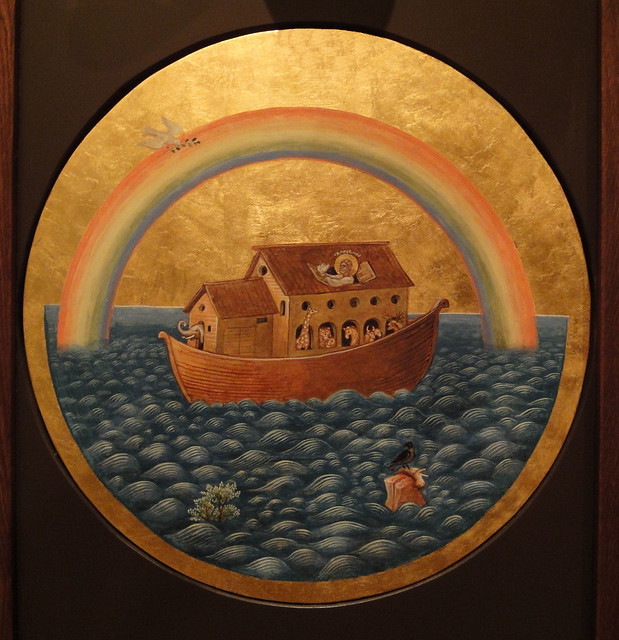
Neverthless, despite our wickedness, God in His mercy always provides a way of escape.  In the days of Noah it was the Ark that was prepared. Noah preached righteousness but he was scorned, until the day the Ark was closed and the waters inundated the whole world. In the days of Sodom and Gomorrah, God sent Lot among the people was a witness to righteousness, and in whose home were the visitation of the Holy Angels. Yet the people, rather than repenting of their sins at the presence of holiness, desired to rape the angels.  In the time of Israel's fall in the wilderness, God gave them ample signs of His Providential care yet they chose to live in unrighteousness, and fell in the wilderness. The Canaanites likewise did not repent and were destroyed and scattered that their evil not multiply and destroy endless souls. Israel fell into the same patterns again and was judged severely, only to have a remnant preserved, and that a mercy of God so that a savior could come through the lineage of Abraham, that the promise of Abraham might be offered to all men, that is the gift of Holiness, the gift of the Holy Spirit, given us by Yeshua/Isa/Jesus, the baptizer in the Holy Spirit, the seed of the Woman, prophesied by Moses in Genesis,  of the lineage of David,  of the tribe of Israel, that our souls might be saved. 

Tuesday, February 9, 2010

Energy in the New Testament- A Concept Lost to both Catholicism and the Reformation

ENERGY IN THE NEW TESTAMENT
AND IN LATER THEOLOGY
© 2000-2003 by Orchid Land Publications
[Last updated 20030623]
i
     Shortly after the middle of the fourth century BC, Aristotle (Physics III.1, Metaphys­ics VIII.3, IX.6) explained the relation between a potential or capacity and its actualization or realization as dýnamis and enérjeia, respectively.  This became part of the thinking of literate speakers of Greek in the centuries before Christ and the holy Apostles.  (For Orthodox terminology in general, CLICK HERE.)
     THE KEY TO UNDERSTANDING THE VIEW OF REALITY PRESENT IN THE ORIGINAL GREEK NEW TESTAMENT AND THEREFORE TO UNDER- STANDING THE EASTERN ORTHODOX CHRISTIAN THOUGHT WORLD (PARADIGM) IS TO BE FOUND IN THE GREEK CONCEPTS OF DYNAMIS & ENERYEIA!

     In the New Testament (and the Septuagint Greek Old Testament) and in the writings of the Fathers and Mothers of the Church, there are numerous uses of enéryeia “energy, operative or actualizing power”), enérgema “effect(iveness), operation,” eneryés “energetic, efficacious,” and eneryeIn “energize, actuate, actualize.”  (These words are cognate with Greek órganon “instrument” or “product.”)  From Aristotle’s Physics and Metaphysics (in the middle of the fourth century before Christ) on, energy in Greek was related to dýnamis “power, capacity, faculty” as actual (realized) is related to potential:  Those who thought and wrote in Greek, including the authors of the New Testament Epistles thought of energy is what makes a potential power actual or real; it is a basic aspect of being, whether created or uncreated (divine).   This may all seem a bit odd in view of the English use of dynamic—which is closer to Greek “energetic.”  
TO AVOID CONFUSION
     From the time of Aristotle, users of Hellenstic Greek distinguished dýnamis "capacity" from enéryeia "energy," i.e. what actualizes a dýnamis.
    In modern engineering science, power is the rate that work is done; work is a force acting over a distance; and energy is the capacity or potential to do work.
     The energ- words are admittedly sparse in the Gospels (despite St. John the Evangelist's emphasis on Light and Life; cf. 1:4, 8:12, 12:36, as well as 1:5,9, 3:19-20, etc. and 11:25, 14:6, in the Gospel alone; cf. 6:53, 17:3, etc.) but are certainly found in the Apostles.  The opening verses of the Old Testament tell us about the “waves” of energy present before the creation of the cosmos (the idea that “water” existed before water had been created is a fantasy); they tell us that the first thing created was light—the purest form of energy.
     In the New Testament, we find 27 uses in the Apostles, of which a small number can be disregarded as referring to the devil's power (see particularly 2 Thes. 2) or the effect of death or iniquity on human beings.   (J. Armitage Robinson's “On energeĩn and its cognates” [St. Paul’s Epistle to the Ephesians, 2d ed. (Macmillan, 1909), pp. 241-247] has just come into my possession; I will be commenting on this very learned article in another writing.)  Readers may wish to look at   It would be worth the reader's while to consult reference works on New Testament word usage—not least, Kittel’s famous (and huge—in English, ten-volume) work and the volumes by, e.g., C. Spicq (Roman Cath­olic) and Colin Brown.  One will find little to the purpose in Kittle and nothing in the latter two works.  Th. Spidlik’s learned and lengthy The spirituality of the Christian East ignores that which is essential—energy; he appears to be a Jesuit of the Unia.  Nothing could be more apparent that that—and why—the West “cannot understand the divergence of Western Christianity from eastern orthodoxy.”
     But just as great an interest is to be found in seeing how energy resolves ten otherwise irresoluble problematic mat­ters in theol­ogy.  One must be careful in dealing with the contrast between erga “works” not energized by Grace and those so energized; cf. Rom. ll:6, etc., as well as passages commented on below, especially Philp. 2:13 in the box.  If we should be well aware that the opposition, erga : enérgeia is a jingle or antithesis that a Greek writer would favor, we should not fail to take note of the frequent Western expression, “state of Grace,” which underscores the West’s static understanding of Grace.  The Latins take Grace to be created and “non-operative” (i.e. non-energetic)—a habit, state, form, or quality of the soul.  The Reformers propounded the idea of Grace as divinely im­puted righteousness—a virtual reality, since the believer remains, as Luther in­sisted, a sinner in fact.
     The reader is bidden to examine for oneself 1 Cor. 12 (on the Body of Christ) with its three uses of energy- and six uses of charisma- “free gift of Grace.”  Speaking of the Body of Christ, 1 Cor. 12:6 says, “And there are differences of energizations (energ), but God is the identical One Who energizes everything in all things.”  Continuing in verses 10-11, St. Paul says that “to another [is given] the energizations of potential(itie)s [the word is dynámeis], . . . ; but one and the same Spirit energizes all of these, allotting to each individual according as He wills.”  Note in passing also 2 Cor. 1:6, Gal. 5:6 (where we read of “faith [pístis, an energizing formation in Greek] energizing through [or: “because of”] love”)—and 3:5 where miracles are concerned—as well as Philm. 6.  Gal. 2 speaks of SS. Peter’s and Paul’s energizing or effectuating/actuating (in v. 8—two uses; v. 9 refers to this as the grounds for the recognition by James, Peter, and John of the Grace (cháris) in Paul.  Before turning to prime uses in Ephesians, Philip­pians, and Colossians—some or all of which are rejected by Liberal critics—note should be taken of 1 Thes. 2:13 (referring to the LOGOS [Jesus Christ] or logos “rational principle” as energizing in believers—which is contrasted with the energizing of iniquity in 2 Thes. 2); Heb 4:12, where the “living” divine LOGOS is eneryGs; and even the un-Hellenic James in 5:16, where the step-brother of Jesus asserts that the prayer of a righteous person ener­gizes. The Apostolic ethos is permeated with energy, as still is the Orthodox phrónema “mindset, outlook.” 
     It is time to have proper translations of verses like Philp. 2:13:  “For it is God [Who is] energizing in you all both to will and to energize for the sake of [His] being pleased”; cf. Gal. 5:6, where “faith energizing through love” is spoken of.
     We can now up the ante by looking at Eph. 2:2 (in Greek), which has the devil ener­gizing in the children of truth, whereas 1:19-20 has dýnamis and two occurrences of the word for “energize”—the overwhelming power (dýnamis) of God “according to the energizing in us believers of His strong might, which energized in Christ to raise Him from the dead.”  (Eph. 1:6 speaks of Grace as “rendering us acceptable”—a single verb in the Greek, one that is cognate with the noun for “Grace.”)  Eph. 3:2 speaks of Grace, while verse 7 in the same chapter speaks of Grace “bestowed according to the Energy of the power (dýnamis) [of God].”  Verse 20 speaks of God as One “em­powered to do . . . according to the power (dýnamis) being energized in us”—evidently Grace.  Are these views of Grace compatible with the static, uncreated "form or quality of the soul" in Latin theology—or with the idea that Grace is divine goodwill in Reformation theology?  
     Eph. 4:16, reflecting 1 Cor. 12:11, says that the Body of Christ is held together according to (or in terms of)  Energy—evidently Christ’s Life.  (Note that Grace is a topic of this chapter in the Letter to the Ephesians; see, e.g., v. 7.)  What Eph. 4:16 says is that the shared Life of the members of the Body, whose “Head is Christ” (v. 15), is expressed in terms of energy thus:   “from Whom [scil. Christ] the whole Body, fitted together [synarmologoúmenon] and knitted together [symbibazómenon] by the supply of every joint, causes the increase of the Body in terms of energy proportioned to [literally:  "in the measure of] each single part for its own edification in/by love."  (The use of “in” for “by” in Biblical Greek is an Aramaicism.)  Energy is highlighted even more in what now follows.  (Note in Philippians that 4:3 speaks of Clement, Paul’s companion—the same person that wrote the famous Letter that speaks of bishops, priests, and deacons.)  While Philp. 2:12 commends “working out” (katherg-) one’s Salvation with fear and trembling, v. 13 adds, as already quoted in the box above, “For 'tis God [Who is] energizing [this is evidently the action of Grace] in you all both to will and to energize for the sake of His good pleasure.”
     Where v. 3:21 speaks of “transforming our humble bodies into conformity with the Body of Christ’s Glory (SHEKHINAH?) with the Energy that enables [the dynam- verb] Him to subdue everything”  . . . Col. l:29 links energy and power [dýnamis] thus:  “I labor, striving according to  His Energy [that is] energizing itself (in) a natural capacity in me [literally, "in me in a capacity"].”  (Dýnamis is here rendered as “natural capacity”; it can also mean “faculty,” in which sense en is often used with it [cf. “in/by love” above].  Col. 2:12 speaks of being buried with Christ in Baptism, “by which also you all work together (synergize in Greek) through the faith ‘of’ God’s Energy that has raised Him from the dead.”  If that is Grace, it is clearly something uncreated because it is the Life of the divine LOGOS.  It is not any sort of  “created Grace.” 
     Let’s not ignore verses with dýnamis, at least not Rom. 1:20:  “For His invisible things from the creation of the cosmos are clearly discerned, known through the things that have been made—[viz.] His eternal capabilities (dýnamis] and Deity, . . .”    
ii
     What is the conclusion of the foregoing (without even investigating the synerg- words)?  A great deal of evidence exists in Paul’s developing thought for an energetic view of God’s (uncreated) Grace—His Life in us—but no evidence can be expected to be found for Grace’s being static—either a created form of a created soul, or simply God’s goodwill that makes virtually real what really is not real, as Luther boasted—so that one can speak of a “state of Grace.”
     Various expressions are found for the uncreated Energies among Greek-language Christians; most are feminine in Greek, as one would expect from their energetic character.   (Enérgeia is femi­nine.  Besides z“Life,” théosis, omoíosis, cháris “Grace,” there is dóxa "glory," in some ways parallel with Hebrew Shekhinah “indwelling, presence” [Ex. 13:21-22, 40:34-38]; for God as a Mother, see Isa. 66:13 in the discussion in the box below annexed to this one.)  Since God (for good reason) ordained Greek to be the vehicle for propagating knowledge of Himself, we would be justified in referring to the uncreated Energies as feminine if we wished.  In view of the absence of grammatical gender in English nouns, we can pretty much avoid the issue.  But we certainly follow the tradition of calling the Father and Son “He”; but the Holy Spirit is both “He” and “It” (note that Pne “Spirit” is neuter) in the New Testament.
     In dóxa “glory” in the New Testament, scholars have found an echo of the Rabbinic SHEKHINAH “divine Presence—the feminine aspect of God in the Kabbalah and the sixth thing that humanity lost at the Fall.  (YHWH is of course gender-free, and we cannot attribute the genders of a human language to some characteristic of uncreated Reality; yet, Isa. 66:13 God has the rôle of a Mother.)  Anyhow, down to the present day, Orthodox theologians refer to partaking of the uncreated divine Energies as seeing and partaking of God's uncreated GLORY; and laypeople speak of arriving in Heaven as seeing or partaking of the true GLORY.  Passages in the New Testament like John 1:14 as well as those in which Christ is termed Light and Life more than amply justify the Orthodox ways of speaking.  Divinization itself is often called “Glorification”; and the  ritual for  proclaiming a person's Sainthood is called “Glorification.”
     To bring all of this together (one may tentatively suggest), we must think of a gradient of more and less Grace, or rather of omoíosis as a vectorial form of théosis, a vector of being energized with more and more uncreated Grace that eventually eventuates in complete théosis.  Adam lacked theosis or he would not have sinned; but before sinning he remained as he had been created—according to the “Assimilation” to God (Gen. 1:26).  The uncreated Grace of omoíosis received in Baptism and partaking of Christ’s Body and Blood in the Holy Commu­nion undergoes those set-backs that every cognizant adult experiences through sinning prior to the ultimate theosis of those in Christ.  Our first ancestors were, unlike us, not subject to death and decay prior to their sinning because they had the “Assimilation to God.”   This was lost at the Fall; the Icon of God was not lost, for the loss of its powers of reasoning and free-choice would have reduced our first ancestors to animals.  The Orthodox believe that the Old Testament Saints also received temporary theosis through aVision of the uncreated Light (cf. the Disciples on Mt. T[h]avor before our Savior’s Immolation on the Life-giving Cross).  While they were freed and divinized in Christ’s Descent to Hades during the time He was dead, permanent theosis comes after death for Christians.  Till then, the Assimilation to God can be set back through an unwillingness to let the all-holy Spirit energize one of Christ’s members to do works pleasing to Him; it can even be lost entirely when those works are altogether lacking.  On the other hand, when the Spirit is energizing (Philp. 2:13) believers to do Christ’s will, they reap Grace for Grace (John 1:16).   Orthodox faithful undergo a con­stant recycling of lapses and restorations, each cycle becoming smaller and farther apart as the faithful proceed along the vector of omoíosis toward théosis—a difference of degree.
     Concerning synergy, St. Paul, after having commented in 2 Cor. 6:1 on our becoming the righteousness of God in Christ, speaks of his readers’ and his own energizing together [with Christ—according to the 1611 translation], beseeching his readers not to receive the Grace of God  in vain.  In Rom. 8:28, the verb in question is used causatively, with the force of all things’ energizing together for good in those loving God.  In Jas. 2:22, we read:  “You see that faith was energizing together with [Abraham's] works” when that patriarch offered his son Isaac on the Altar.  So much for the verb, synerg-.  Some of the numerous uses of the adjective or substantive occur in St. Paul's Epistles and (several times) in one passage of St. John's third Epistle (see below).   These are rendered as “fellow-workers” or “joint-laborers” in the 1611 English translation.  Though not wrong, this rendering hardly conveys the energetic overtones of the Greek thought world.  Interestingly, St. Paul in 1 Cor. 3:9 refers to himself and Apollos as God's fellow-energizers or fellow-workers.  In 2 Cor. 1:24, Paul speaks of himself and others as synergizers “of your people’s joy”; in 3 John 8, joint-energizers for truth are spoken of.   In three occurrences in Rom. 16, in two place in the Letter to the Philippians, and once in 1 Thessalonians 3, Paul refers to various men and women as his fellow-energizers or fellow-workers—once “in Christ Jesus.”  In 2 Cor. 8:23, we read that Titos is Paul’s companion and joint-energizer for/in regard to his readers; and in Col. 4:11, Mark and Jesus Justus are Paul's fellow-laborers or joint-energizers.  

iii
 
     God is called Light, especially in the Gospel according to St. John the Evangelist.  In contradistinction with the uncreated Energies or Life of God, the created cosmos began, as already noticed, with God's creating light (created energies) first of all.  The reader interested in a few subtleties of the concept of divine Energies is recommended to read V. Lossky, Mystical theology of the Eastern Church (1957, pp. 78ff); earlier in the same chapter, he discusses the overt patristic development of this Greek-language, Biblical concept.  (It will seem quixotic that, p. 86, he main­tains that the presence of the uncreated Energies is not causal, even though they divinize--a causative verb!  A few pages later, Lossky makes it clear that his state­ment is meant to indicate that the uncreated Energies of Grace are not effects in the created world--as in Latin theology.  In Orthodoxy, Grace is a cause, not an effect; in the West, one speaks of a "state of Grace."  The idea is not unique to Orthodoxy; other religions have entertained similar ideas--most obviously Zoroastrianism and Shin Buddhism--whose Amida-Butsu is the Buddha of immeasurable Life and immeasurable Light.  
      That Orthodox writers have thought of light (and particularly the uncreated Light--God--which the Johannine literature in the New Testament combines with Life in reference to Christ, the Life and Light of the world) as energy, and particularly as the uncreated Energies of God, may surprise the modern mind, whose theological outlook is likely to have been formed by the static categories of Western scholas­ticism--Latin and Reformation.  Both of these frameworks lack the concept of energy.  Indeed, the more surprising it seems to the modern mind, the more interesting it is, given a similar relationship in current scientific theory.
      While the Bible begins with dark nothingness and formlessness, before God said,  “Let [there] be light,” today’s scientists see the generation of light at the begin­ning of the cosmos--which then faded into cosmic darkness, “a formless sea of dark matter“--for a period of 300,000 to 500,000,000 “years” after the Big Bang.  As this period offers no evidence to astronomers, how, in what unfathomable way, the architecture of the modern cosmos emerged out of this chaotic “void” and (according to a British cosmologist) light came on again is the “most important un­solved problem in astronomy.”  The Orthodox believe that the creation continues, for if the Creator did not hold up the cosmos at every instant, it would vanish into nothingness.   Creation is neither timeless nor a Gnostic recycling of time; novel forms of being emerge as time flows onnew planets, new creatures.  The Creator is, in short, energetic, not limited to one act or one kind of creation.
    This comes  from the last column of a very interesting article by the distinguished Astrophysicist M. S. Turner in The Sciences (published by the New York Academy of Sciences).   We read on  p. 37:  "Dark matter and dark energy are the yin and yang of the universe.  . . . Dark matter, like all matter, draws mass towards itself . . . Dark energy, in contrast, is repulsive, and it is distributed smoothly throughout the cosmos."  Mention is made of "mysteries," and of course creation is the issue.  "If [the studies] are correct, dark matter and dark energy account for the vast preponderance of the cosmos:  about 95 percent . . . "       
     The volcanic fires and frightening roar of Mt. Sinai described in the Exodos narrative indicated to Moses the power of God-- (the Presence of the Lord's glory).  But I leave that to some thesis-writer who knows more about the matter to assess the validity of this parallelism.  When one comes to think of it, language needs a parallel to organic which embodies the idea of energy--perhaps enorganic.  (Both erg and org are, at least etymologically, related to English work; the roots were werg and wrg.  While early Greek retained w in the form of F, it was lost by Classical times, just as h got lost in the Hellenistic era—along with—and earliest in Palestine and Egypt—most  of the sound changes of Modern Greek.)
      If light, energy, matter, and even life are seen to be different forms of the same thing in twentieth-century science, Orthodox theology accepts Mysteries (sacraments) in which corporeal (i.e. material) entities like bread, wine, water, oil, etc., have the capacity of channeling the divine Energies to human beings--as the result of Christ's Incarnation--which has been traditionally regarded as the "First Mystery (Sacrament)" of the holy Faith.  All of this is a  wholly different world from the Denominationist volitional-juridical framework in which word plays the same central rôle that energy plays in Orthodoxy.  Even Jesus Christ is a “Word” in the Denominationist approach to or version of Christian belief.  In the Denominations, words and sermons replace the Orthodox Altar (some Denominationist preaching houses have  meaningless, non-sacrificial prettifications called “altars”) and the Body and Blood of Christ.  For Calvinists, sermons are what validate the virtual reality of a sacrament--and can effect the same end without a quasi-sacrament.  Such sacraments are (judicially) termed “ordinances” by other Protestants, and the bread and wine used in the Lord’s Supper are called “to­kens” or “emblems” by some Denominationists.  Note also that sacrament  originally had the juridical sense of an “oath.”  What different worlds the Latin-Germanic thought worlds are; where is the resemble with Apostolic thinking?  
     Though the concepts of energy in science and early Christian thinking have emerged in very different conceptual frameworks, have different connotations, and indeed are differently defined, such parallelisms as have been noted (and which there would be no point in denying) are worth reflecting on in the debates over science and religion and in comparing the merits of Eastern and Western theological thinking.  The energies have an intimate and vital connection with talk about God and with Salvation in Orthodoxy.  Is it not probable that the parallelisms of these concepts in such separate disciplines—one ancient, one modern—reflect  a glimmer of ontological and theological truth?    Only a very biased person or an irreformable Gnostic would reject the idea out of hand.  At all events, don’t the static categories of Western theology lose their appeal in the face of the way basic concepts of East­ern theology seem not to be in fundamental conflict with those of current science?  Note that the argument is , the way some theologians on the liberal antitraditionalist left (in contrast with the Fundamentalist antitraditional­ist left) would maintain; the position is rather that any defensible coïncidence between the two disciplines should be welcomed.  More can be said, but let the foregoing suffice.
     Despite the "energetic" nature of contemporary physics, the attitude of most physicists towards time is very different from that of Orthodoxy.   Aristotle (who got “taken in,” as one writer has put it, “by friction”) considered the natural state of motion to be rest.  Modern physics looks at it differently.  But if time was cyclic for the Platonists and static thought characterized Western scholasticism and classical physics, physics has followed suit:  Physics has been time-neutral in the sense that time is reversible--though only in unstable systems, the crux of the matter.  Some scientists are now protesting this position, since a timeless cosmos defies common­sense.   So  there are moves afoot (or abrain) to change this situation in favor of a physics in which time is unidirectional.
      The divine Energy of which the New Testament speaks is normally invisible but can be miracu­lous­ly revealed to human beings in the perceived effect of created light. On Mt. Tabor (Thavor) just before Jesus's capture--which led to His trial and Crucifixion, the Apostles were miraculously permitted to behold the Light.  The lives of the Saints contain many examples of others present seeing a glow of light on a Saint's face or surrounding a Saint's head.  When the Communists shot and killed a large body of Orthodox clergy and monastics in Kiev, not only the Christian faith­ful but even the Communists were reported to have seen halos surrounding the Orthodox temples of the city.

iv

    Since actualizations or activations of the powers of knowing and (especially) willing are energies, could a Denominationist embrace of energy offer a basis for reconciling the Reformation's exaltation of will above being and reason and Eastern views of Worship and Salvation?  While such a possibility is extremely remote on several grounds, it would offer ecumenists potentially more fruitful gardens to till than the fruitless gardens they have been wont to till.  If any compatibility with Orthodoxy should be aimed at, an embrace of will as energy might conceivably led to embracing ontological energy it special functions in knowing, willing, etc.  But Denominationists would have to integrate the rôle of creation—i.e. created matter (Incarnation, flesh, water, wine, bread, oil, bodily resurrection, icons, etc.) and time (the rôle of tradition in unfolding truth and sifting out error from the original deposit of truth—and in perpetuating the priesthood)—into their understand­ing of Worship and Salvation.   But their accepting creation’s having been destined to have a spiritual purpose (as a vehicle of the uncreated Energy of uncreated Grace) and time’s having a similar purpose (in tradition’s sorting out from errors the one truth able to stand for millenniums) seems, humanly speaking, not to have even a remote chance of occurring. 
     Besides respecting created matter and time, some respect for the Hebrew-Hellenistic location of Jesus's upbringing is essential.  But how can even a literalist Denominationist give up one’s view that the Holy Spirit did not steer the faithful "to all truth" (John 16:13) during the fourteen centuries between the Apos­tles and Reformers?  That has about the same chance of occurring as the pope’s admitting fallibility in speaking ex cathedra.  If the equality and coëssentiality of the Father, Son, and Holy Spirit has so deteriorated among many or most Denominationists as to widen the gulf between them and the conservative holy tradition more than ever, what point is there in discussing human concerns (Salvation) in the first place?  St. Eirenaios, in his famous treatise against the heresies [V.xiii.3] of second-century Christianity, said that immortality and incorruption come "not from one's own being; it is rather through the Lord's Energy [that there exists] the ability for immortality to overwhelm death and  incorruption to circumvent decay."  
     If it would be illogical to say that the all-holy Trinity is one and three in the same respect but is holistic to say that He is one in one respect (Essence) and three in another way (Hypotheses), what of extremist positions that deny the oneness or the threeness--or the complete divinity and complete humanity of Jesus?  Note that Jesus was not truly human if sin is congenital in human nature—as not only with Calvin (who spoke of humanity as being totally depraved) but also the translators of the NIV Bible, who in various places render sárx “flesh” gnostically as “sinful nature.”  It would be syncretistic to say with the Hindus that there is more than one God.  It is extremist (not to say truncated), though internally consistent to say that that Jesus Christ is not divine (as with the Jehovah’s Witnesses and Quakers), not originally divine (as with Nestorians and Mormons), or as One whose Divinity has absorbed his human nature (as with Eutychians and others of like belief); but it is holistic—and both internally consistent and externally logical--to say that Jesus Christ is a Mystery or Sacrament—no less truly human than completely divine.  Given the last account, it is as obvious that human nature cannot be sinful as such as it is obvious that guilt and merit cannot be inherited or transferred from one person to another unless they are ontologically or covenantally one.  But the virtual reality of a covenant would mean that their oneness would be virtual and imputational; so Adam’s guilt can be attributed to a newborn, and the pope can transfer Saints’ merits to those who fulfill the conditions of an indulgence.  But, however alluring, all of this is far removed from energetic being and sharing Christ’s Life and the other Energies of Grace.
     On the side of logic, consider the way the Energies resolve Western dilemmas.  First, Grace vs. works:  Instead of complicated juridical theories of Satisfaction, Atonement, Redemption, Imputation, Justification, Adoption, Regeneration, "Covenantal" Unity with Christ, etc., Orthodoxy sees the incorporation of a believer into Christ by the Energies of Grace as a member of His mystical Body to mean that He and the incorporated member share the same Energies and Life:  What Christ has done His members share--ontologically, not by imputation (will or intention); and the good works that the Holy Spirit energizes in His members by the Energies of Christ’s Life—Grace—when His members consent to coöperate with the energization (without which it would not be forced on them) are obviously Christ’s works.  See Philp. 2:13 in Greek!  There is no diminishing of the rôle of Grace here, as there is in the paradigms in which Grace and saving works are mutually exclusive.  Salvation is St. Paul’s new creation, as observed earlier; it is ontological rather than juridical.  The Crucifixion is a latreutic Sacrifice as in the Epistle to the Hebrews, not something properly characterizable with those juridical categories.  Grace received is implemented for the reception of more Grace (John 1:16).  When Christ’s Body and Blood are offered up on the eucharistic Altar, He is the Offerer in the faithful, and they are offered up in Him.  The faithful participate in Christ’s One unrepeatable Offering on the Altar of the holy Cross, though the divine Liturgy repeats only the Anaphora or Oblation, not the unrepeatable Immolation on the Cross—which communicants nevertheless share in as Christ’s members.  Since Salvation is incorporation (the means) and Divinization (the goal or result), how can our becoming members of Christ's risen Body make sense without the concept of sharing energies?  How is Divinization thinkable other than through partaking of the uncreated Light or uncreated Energies of God--when the saved really see God--not his unseeable and imparticipible Essence, but certainly the effect of His divine Energies? 
      Second, instead of positing a depraved human "nature" and the loss of the Icon (Image) of God--i.e. the loss of reason and freewill--in the post-Augustinian Western manner, Orthodoxy distinguishes the Icon of God from the Assimilation or Cognation of God ("Likeness," the 1611 rendering, would proper translate [h]omoí­oma, whereas the Genesis text has got the more active [h]omoíosis).  In accord with both Genesis and New Testament passages as well as various God-bearing fathers, including SS. Eirenaios and Maximos the Confessor, it was the Grace or Energy to please God, the omoíosis Theô, that our first ancestors lost in the Fall.  If the Fall was the loss of Cognation with God, it was not a loss of the Icon (Image), which is an inalienable part of human nature.   Losing the reason and freewill of the Icon of God, as the Reformers taught, would yield animals, not humans.  St. Athanasios the Great  expresses the matter in his famous treatise "Concerning the Incarnation" by saying that humans (not my translation) . . .  "were bereft of [i.e. lost] the Grace that belonged to them as creatures [made] in the Icon of God . . . it was in the power of none other than the Icon of the Father [viz. the Son] to re-create for humans the Assimila­tion/Cognation of the Icon."  St. Maximos the Confessor avers that the loss of the Cognation (Assimilation) of God is revealed in the imperfection of fallen human nature.
     It defies reason and commonsense to maintain, in the Western manner, that a nature can sin or has sinned; only individuals can sin.  Where the Reformers allow guilt to be inherited—by impu­tation or otherwise—and merits [of Christ or of the Saints] to be transferred by, the East rejects inherited guilt and inherited merit:  We share in Christ's goodness not by imputation and nothing more, but ontologically—including our eating His Body and Blood in the most holy eucharistic Mysteries.  Those who speak of Christ’s body’s being spiritual present in the great Mystery don’t know the difference between body and spirit.  The Calvinist idea of a virtual presence in a communicant with proper subjective faith when the ceremony is accompanied by a proper sermon has drawbacks that hardly require pointing out.
 potential, and the Cognation or Assimilation is energetic, bring to communicants the theanthropic Life of the God-man Christ and Divinization through the Vision of the uncreated Light--God's very Being, but not His Essence—or, as some prefer to say, the Vision of the effects of the uncreated Light, how are we to understand Mat. 5:8?  There we read that the faithful will see God, while 1 Cor. 13:12 says we are to see God "face to face"—which could only refer to the humanity of Jesus Christ, since God's Essence has got no "face."  Various notions of what these verses mean have been essayed, and only one holds water.   If humans became part of the divine Essence, that would amount to their "Deification" (apothéosis)--and there would then be more than three Persons in the divine Trinity; it would not be the théosis ("Divinization") that the Fathers and Greek theology speak of.  The Glory that John 17:22 relates Jesus's bestowing on the faithful—it has been held to reflect the Hebrew Shekhinah—has been inter­preted in Orthodox Christianity as the uncreated Energy of God--the divinizing Light that the faithful will behold in Paradise.

v
     Instead of borrowing energia from Greek, scholastic Latin glossed enéryeia as operatio and actus and eventually spoke mainly of potentia or virtus and actus ("act[uality]") as, respectively, matter and form—thus losing the import and vitality of Greek "energy"!   As for Aquinas, the distinguished Jesuit philosopher, Bernard J. F. Lonergan, in his volume, Insight:  a study of human understanding (2d. ed; p. 434 fn.), explains that Aquinas makes a threefold distinction in which there are two kinds of act.  (Lonergan even refers to Aristotle's Metaphysics IX, lect. 5,  1828 f.)   It must be remembered that the Aristotle that the Sholastics relied on so heavily--as the interpretive "form" that they imposed on the "matter" of Scripture--had lost its connection with Biblical and early Greek-language Christianity (the hiatus of 730 years of Dark Ages and illiteracy was decisive) and relied on a third-hand Aristotle, received in Latin translations of Islamic Arabic translations of the original Greek.  Prime matter is a universal "thing," a potential for any form; two kinds of "act," were distinguished (according to Lonergan) into actus/actio/operatio ("potentia to forma," representing Greek enéryeia, distinct from Greek poíesis "doing") and forma itself (potentia to opera­tio).    Lonergan says that "the systematic significance of this triad is evident not merely in the threefold composition of material substance but also in the role played by potency, habit, and act" (Lonergan cites Aquinas, S.T. I-II, q. 6, Introd., & q. 49, Introd.) in Thomistic writings. The Latin scholastics took essence to be energy and characterized the divine Essence as an Energy:  Actus purus was meant to mean pure energy, the absence of any unfulfilled potential.  The Reformers specified that the energy in question is will, whereas for the Latins it is existence--and is more rational than volitional.  But energy always remained a function of essence in the East, separate from essence but identical with the divine Being.   Like that Being beyond being, God's Energies (including Grace operating in the cosmos) are uncreated.  (Some thinkers separate nature form essence, the former being a function of the latter; this conceptualization works well for 2 Pet. 1:4.)  Since essence and energy (actus) are not distinct in the West, there is no real distinction between théosis “energetic Divinization” and apothéosis “Deification in essence.”  Latin Grace is created (but “supernatural”—i.e. not part of nature)--an entitative, not (since Aquinas) an "operative," form or quality of the soul, with form being under­stood as a definer or  realizer--a sort of actualization.  It is through this created means that the Latins, as Fr. John Romanides points out, think they can partake of the uncreated Essence of God.  But if that participation is not entitative but only intentional, then it is not real but like the Protestant idea of volitional or covenantal unity of believers with God--i.e. with the divine Essence--since neither Latins nor Reformers distinguish energies from essence, and indeed conceive of and define the divine Essence as energetic.
     Thomas's followers more or less reduced actualization to form in the pair, matter : form; but they retained a distinction between habitus entitativus (sancti­fying Grace) and habitus operativus.  Sanctifying Grace, in contrast with Grace in Orthodox theology,  is not "energetic."  Thus did the scholastics distance them­selves ever further from the framework of the Greek New Testament and Orthodox theology.   Protopresvter John Romanides has pointed out the scholastic paradox of partaking of uncreated Essence through the created means of sanctifying Grace—defined as created by the scholastics.  In connection with energy in science, Lonergan, links energy to inertia (Insight,  pp. 443-444 ) in the pair inertia : energy.  Whether this relating of potency : energy to the inertia :energy of current science is durable is not for me to say.   (Lonergan himself puts a question mark after this suggestion.)
     The Latins make the divine Essence to be the Energies of existence and intellection.  They teach, according to Jürgen Kuhlmann (Die Taten des einfachen Gottes:  Eine römisch-katholische Stellungnahme zum Palamismus [1968, pp. 98-99] that the participation of the faithful in the divine is an "intentional" (by will), not "entitative" (i.e. ontological) participation in the divine Essence--not too different from the federal or covenantal participation of believers in Reformation thinking.  The conceptual world of the Christian West is thus separated from the conceptual world of the East by over a dozen centuries in a framework that imposes quite diverging meanings on the words (matter, content) of Scriptures, etc. from the Greek-language conceptuology of Orthodoxy.   For example, John 15:26 no longer differentiates the essential  procession (ekpórefsis) of the Paraclete from the Father alone and the energetic and  mission (ékpempsis) of the Paraclete from the Son in the economy or dispensation of the created cosmos.  The Orthodox notion of energies as life light has some parallels, despite the different paradigm, with energies in contemporary scientific thinking.  (In contempo­rary physics, energy is a form of matter as well as existing in the form of light, etc.) 
     Form is self-evidently a considerably more static concept than energy.   This dividing line between East and West has had the greatest consequences, including the analogia entis with all of its portentous consequences.  (This outlook insists on the parallelism of the Holy  Spirit's energetic sending by Jesus Christ with His putative procession from the Son as well as the Father in the divine Essence--the heresy of the Filioque.)   Where matter has a potential for almost any specific “form” in the West, at least in the East, the divine Energies are spoken of quite broadly--unified though not undiversified, functioning to effect different purposes and being realized in different forms--Light and Life (Grace) as well as other operations or functions, perhaps even as a “form of matter,” as in modern physics.  Grace functions to enable a member of Christ’s Body to become such (here it is "operative," as a scholastic would say) or to be what it is (here, it is "entitative," as a scholastic would say; but Eastern Grace is not subcategorized into the roughly one dozen kinds of Latin Grace.)  Thomas’s epigones lost a good deal of the idea of operatio while nevertheless preserving the distinction between sanctifying Grace as an entitativus--but not operativus--habitus.

FOR THE EARLY DEVELOPMENT OF ENERGY
  in the Fathers, see G. L. Prestige,
God in Patristic thought (SPCK, 1952)
and A. J. Sopko (CLICK HERE),
The theology of John Romanides (Synaxis Press, 1998)


Wednesday, January 20, 2010

Alzheimer's Disease- A Monk's Perspective

This is a paper written by an Orthodox Christian monk and priest as he contemplates his Alzheimer's disease.  He has had the illness for four years more or less.  It is a triumph of faith and hope and of love.


"This is a copy of a message I sent to good friends here who were inquiring about the status of my Alzheimer's Disease and were wondering if it is even even appropriate to ask.  After I wrote it I though I would share it with you and a few others, and you may share it with anyone you think might also be interested. Here is the message, below:


It's quite all right for you to ask.  I am very open about my illness, as is Gerondissa, and we do not hide anything or keep any secrets.  And I have very little false pride about my limitations any more--I've already been through "that phase" and have been able to embrace my disease in the shadow of the Cross.  More than that, I have begun the slow process of climbing up onto the Cross with our Lord, and sharing now in His Passion.  This is incredibly sanctifying; I don't know how else to describe it. So although I don't talk much about my illness, it's not out of secrecy or pride or sensitivity, but only because I am keeping the Lord on the cross as close to my heart as I can.  And He will get me through.  It has frankly become as much a spiritual experience as a mental one.

So, I want to take this opportunity to share with you and Bruce, since we haven't really talked about it much.  I have discussed it on several occasions with Dewayne and Janet, and they are wonderfully and appropriately sympathetic and helpful. They are more than relatives; they are good friends.  I will talk more about it with my other siblings when we have a family reunion this summer.  My children are completely on the same page with me already, but for them it is too painful to talk about much.

This illness is the oddest feeling of being somehow detached and experiencing a slow metamorphosis from being one person into another; not dramatic, but disconnected, and yet still able to pray, read, do email, recognize others (although my short term memory and my malapropisms have gotten worse over the last week).   But at the same time it's oddly not depressing.  (I went through the depressing stage last year.) In fact, I woke up this morning with Shadow having crawled up and curled into my left arm, and at the same time I had the most intense longing for heaven, which made me very happy.

The neurologist told me some time ago that there is a small percentage of AD victims who in some way consciously "know," all the way through, what is happening to them, and he thinks I am one of them.  I don't know if that's a blessing or not, but I do think it's a blessing that I can share with others the various stages of this illness as long as possible.  That sharing is helpful to me, and perhaps for others if they see that there is a spiritual way to "do" something that is otherwise so awful. 

As you and Bruce know, Alzheimer's is a long and slow process, for which reason it's called "the long goodbye."  But I read Patty Davis' fine book about her father, President Reagan, "The Long Goodbye," and she said that he remained cheerful, happy and polite as a three year old, right to the end.  And I also know about the Alzheimer's of some great and holy Elders of our time, who were able to serve Liturgy and say the Jesus Prayer right to the end, even when they no longer recognized anyone else.  So Alzheimer's doesn't have to be grueling and ugly, the way it is so often portrayed. I think that the perceived "terribleness" of this disease is at least in part a reflection of our incredibility morally and spiritually bankrupt culture.

With drugs and medical help, and very good care from Mother Beattifi , I have had three years of relatively slow deterioration, and I think that "slowness" will continue yet for some years.  Right now is a different phase, though. I am very blessed to be in monastic life and here with Mother and the Fathers and Brothers just down the road, who also stay in contact and are very affectionately supportive.  I feel safe and well cared for.  There are many in my condition who cannot say that.  Mother is a good friend, caretaker, intellectual and spiritual companion, but you and Tim will have to help her to harden her heart as time goes on and my symptoms become worse. I have already spoken to her about this, too. She is very tender-hearted and quietly suffers over my illness, although she's no drama-queen about it, as you can well believe. That's not her style. She only quietly says, "I don't like it," and that, coming from her, actually says a great deal.

From a purely spiritual standpoint I want to share with you the insight I believe God gave me from the time of my diagnosis.  My greatest and overriding sin--indeed, even vice--has always been pride.  Pride of mind, of "knowing better" and judging others inappropriately, sometimes thinking of them as being less than I am.  This is a most grievous sin, and one that many people don't even recognize in themselves, but it is the one sin that will, above all, consign us to hell if we don't overcome it!  It was the sin of Satan, the sin of Adam and Eve. 

I understand fully how I got this way. I have throughout my life been inordinately proud of my mind, my intellect, my ability to think clearly about difficult and complicated things, to speak and write well, understand, process, and explain difficult things, etc. Growing up, I wasn't good at sports, I wasn't attractive to the ladies, I couldn't dance, I was an intellectual bookworm and loner, I had no other skill than my brain, and I used it and developed it as far as I possibly could, although actually I wasn't particularly academically brilliant, as all of that just seemed like some kind of superficial "game" to me.  But that was my path in life.  And although I have put these gifts to the service of Christ and the Church, as best I could, the pride has still been there. 

Now the Lord has offered me a chance to mortify and humble down that pride, by accepting without complaint the slow crumbling of my mind.  And I do accept this, with my whole heart, even if with the occasional tear, as a gift from Him for my salvation.  So it sometimes "feels" as though this dying of various parts of my mind is also a dying of self, a dying of ego, a dying to pride.  And isn't that the purpose of spiritual life, after all, anyway?  The Lord looked down and saw that I wasn't going to do it any other way, and so, because He loves me very much (unworthy as I am) and wants me to be with Him forever, He offered me this incredible opportunity to die to self.  I see this as a great, if sometimes painful, blessing!

Well, these are my few thoughts about it.  Never hesitate to ask me how I'm doing.  I will tell you honestly.  But never feel sorry for me, or pity, as I do not for myself, but rather rejoice for me that I am on a sure path to the Kingdom of Heaven.  I believe this with all my heart.  --Fr. A"

Saturday, October 24, 2009

The Toss of a Coin


My young family was in a small Christian Group, hosted by the Rosencrkans family,  a unit of the Evangel Temple Assembly of God in Springfield, Missouri. I had suggested one of two possible activities for the group to pursue. I was adamant and they acquiesced to a coin toss to decide which of the two activities we would pursue.  We tossed the nickel into the air over the table, to decide the outcome. The nickel went up into the air and landed on the table, and it ..... balanced precisely on its edge and stood their, neither heads nor tails. It was met with gales of unbelief and laughter, putting me in my place and showing the great humor and intimacy of the Lord our God, the God of Abraham and Isaac, and of Jacob, resurrected in the person of our Lord, Savior and God Jesus Christ!

Wednesday, October 14, 2009

God is a Fly Fisherman- A BMW Story


Back in 1984 or 1985 I was a podiatrist in a new practice and quite poor and having trouble getting to my job and to my surgeries in my old Volvo.  In frustration I prayed and complained to the Lord, "Lord, I have never had a new car, and I need a car to get to work."
I talked to my wife and she agreed that I needed reliable transportation. One day we were out driving and on impulse pulled into the first car dealership that we saw.  It was a Chrysler, Mitsubishi, BMW dealership.  Right away our eyes fell on a specific spiffy white 325 BMW.  We were having fun so we took it for a test drive. We liked it.  The interior lights were cool, it was tight and handled great, and the engine sounded like a jet fighter.
We liked the car.  We also had no money, and our convictions made us believe that such a purchase flew in the face of  Christian teaching on modesty and stewardship.  So we said, 'thank you very much' to Ron, the car salesman, and left.  However, we were very drawn to that car and it seemed to us that the Holy Spirit wanted us to get that car.
We thought we were imagnining things, so we went and looked at a practical car, a very nice Toyota Camry, also white.  It was a great car but we felt a 'no', in our hearts.  Well, fascinating. This went on for a few weeks and we went back and looked at the BMW again and still found the peculiar 'leading.'
We were going to a charismatic chuch and told a lady at the church about this particular adventure.  The next week she came up to us and said,  "I had a dream or a vision and I saw the initials B.M.W.  in a column and they spelled out Ben Marston's Wheels."  This was quite interesting and also raised the question- is this of God or from somewhere else?  We had to test the spirit.
Finally, one day I went for a prayer walk at lunch as was often my custom and I told the Lord "OK, Lord, it seems you want us to have that BMW, and that specific model.  But if you want us to have it, you will have to get it for us because we don't have any money."
I returned to the office and the postman had just come and left and in the mail was a letter informing us that a house that had been given to Mary in the passing of her parents had been sold and we were to receive enough money to cover the cost of the BMW plus some. Wow.  We got the car.

In the process we struck up a friendship with Ron, the car salesman.  Some time later he came in to my office as a patient. He was dying of an autoimmune disease that was destroying his kidneys.  He also had a leg pain that he hoped I could help, and I managed to help him with anesthetic blocks to his common peroneal nerve that would last a period of time.  It seemed to me that something spiritual was going on in his life, and so I invited him over to our house for a prayer meeting. Mary and I had an interesting way of cooperating in prayer meetings with the gifts of the Spirit working to inform us supernaturally and to empower the prayers.
We began praying for Ron, and he went unconscious and something took over him. Mary had been forewarned by the Lord and Mary bound a spirit that had put Ron in a martial arts position to take us out.
The thing then made him bend the knee at the name of Jesus.
We backed off and allowed Ron to 'surface.'  We told him was was going on, and asked him if there was any sin that he needed to confess and we prayed for him and he remembered an instance on one of his four tours of duty in Viet Nam with special forces. He had killed a Russian advisor to the N. Vietnamese in Cambodia, and he had killed him by a knife stab to the right kidney.

Now that was very interesting. Ron, was dying of kidney failure and his right kidney was already at zero percent function.  So we suggested that he repent in prayer for the killing.  He did so and then we laid hands on him and began to pray for him.  Mary saw the room fill up with angels, and Ron said somewhat the same and thought I had picked him up off the ground.  It was quite an experience of the power of God.
After that Ron got better, and over the next several weeks his kidney function progressively restored being documented by the kidney function tests he took regularly.
Afterwards, Ron, who was still quite troubled by the horrors of special forces and four tours in Viet Nam, wound up in prison, but the combination of events eventually led him to surrender his life to Jesus and he became a quite sweet believer.  He died at a young age.
A few years later Mary and I were becoming Orthodox and were learning to accept the communion of Saints. Mary and I were driving about on her birthday and suddenly it seemed like Ron was wishing her happy birthday in the spirit; I mentioned it to Mary and she said the same thing was happening to her.

Ron, from his vantage place in heaven, was helping us now along the Christian way.  The BMW was a blessed car and saved me in the midst of an interstate wreck.  Finally I had to sell it due to an economic reversal, and wound up with a black older car- just in time for our sojourn with the Mennonites who would have frowned at the extravagance of our spiffy, yuppie white BMW.

Friday, October 9, 2009

The Communion of Saints- Profoundly Scriptural


Hebrews 12 is the Scriptural basis of the Communion of Saints. What do I mean by the Communion of Saints?
The term is from the Apostles' Creed, a Creed confessed by many bodies of Christians.  The communion of Saints is the mystical spiritual reality that in Christ there is a fellowship within the Church between those in heaven and those on earth and transcends the limits that were hitherto imposed by death before the Victory of Christ, with his death, the harrowing of hell, his resurrection and asencsion.  In the Communion of Saints, we pray to Christ, and ask the prayers of those whose victory in Christ has been won.  In the Communion of Saints, those in heaven follow the example of their head and make intercession for those on earth.
The doctrine of the Communion of Saints scares many Christians in the Protestant tradition, especially in the Evangelical quarter of that movement. It scares them because it does not to their way of thinking have Scriptural foundation. To many the invocation of Saints makes them think of the Old Testament prohibition against necromancy, mediumism, and brings to mind the mediumistic calling of of Samuel by the witch of Endor for King Saul in his time of abandonment by God.
It used to bother me too, and I once wrote a tract in which I expressed my feelings at the time that there was simply no need for the invocation of Saints because communion with the Lord was so fulfilling. 
Along the way I became an Eastern Orthodox Christian and part of that is the acceptance of the doctrine of the Communion of Saints, and we do ask the Saints for prayer.  On the way to Orthodoxy I had a number of interesting experiences that helped to re-shape my thinking, but the most helpful thing for others confronting this issue is to re-visit Scriptures that I think point clearly to the Practice as being firmly based on Scripture. 
To see the Communion of Saints based squarely on Scripture one must have a certain viewpoint of Scripture.  Scripture is not systematic theology. Most of the New Testament was written in order to fix things that were going wrong in the Churches that had already received the full Apostolic Tradition by the teaching of the Apostles- before any  of it had been written down. So Scripture as we have it today was not written to be a complete treatment of the fullness of the Faith.  However, Scripture is the supreme expression of the Faith and so the things that exist within Christian Faith and Practice must find concord in Scripture. However, there are things in the Christian Tradition that are not explicitly stated in Scripture. For example, we are never commanded to celebrate the Resurrection on the first day of the week. However, that was the universal practice of the Church from the beginning.  Scripture itself tells us that we are to observe the written and oral traditions of the Apostles.
 2Th 2:15 Therefore, brethren, stand fast, and hold the traditions which ye have been taught, whether by word, or our epistle
So, it is possible that a practice in the Church not be expressly commanded or exampled in Scripture yet be fully in accord with its teaching.  This is the case of the Communion of Saints.
It is not expressly commanded or exampled in Scripture but it is fully in accord with It and is a valued part of the Apostolic Tradition.

The Old Testament did not give us any example of the Communion of Saints.  The righteous dead reposed in the place of Abraham's bosom, which was a place that was not torment but it was separated from Paradise and a place of longing by all the righteous of the ages for full redemption promised by the Law and the Prophets.    It took the formation of the Church as the Body of Christ to accomplish two things so as to make the Communion of Saints a reality.  The victory of Christ in his death, resurrrection and asension populated Paradise once again with the righteous of all ages.  And by virtue of the Union of all believers in Christ, whether on earth or in Paradise as members of His body, a communion was established in the Holy Spirit, that hitherto, did not exist, and was a totally new order of existence for human beings.  This spiritual communion in Christ that comprised believers in heaven and on earth laid the conditions for a first fruit as it were, in anticipation of the Resurrection, the full restoration of all of Humanity in Christ. This first fruit was a spiritual communion that all believers, everywhere have in Christ-whether in heaven or in earth. 
It says it in Scripture  'if we walk in the light as He is in the light, we have fellowship with one another.' I John 1:7
There is nothing in this that limits the fellowship to those on earth, and the Church is one body, both in paradise and on earth.  Further, it is a fellowship where one member cannot say of the other, "I have no need of you." , which is the theme of I Corinthians the 12th and 14th chapters, concerning spiritual gifts.    This applies not only to the brother standing in the Nave of the Church across from you but also to the brother, now sainted, standing in the heavenly throne room.  You have need of him and those reposed in Christ awaiting the General Judgment have need of us.  The Scrpture says as much. The foundation of the Church is the Apostles and the Prophets- not 'was' the foundation. Is the foundation. 
There is a mutuality of dependence that exists across the gulf, uniting the Church militant and the Church triumphant.   This dependence is explicit in Scripture.  Jesus Christ the man, ever lives to intercede for us.  Christ is the example for all those in Him in heaven to follow.  Do you think that Christ is ever living to intercede for us, and those who follow Him, their captain, their elder brother, their Savior and their God, do not?  No, those in heaven, who see Him as He is, are like Him, having been made more fully than we can possibly imagine, partakers of the Divine Nature.  As Christ intercedes for us, soalso do the Saints who follow Him. Sure, his mediations are unique for He is the only mediator between God and man, according to nature- for He by His one Person united forever both to the Divine Nature and to the Human.  By His unique existence He is the only mediator between God and man. However, according to grace, there are many who participate in his intercessions, who participate in his mediations, not according to nature, but according to grace. 
Hebrews 12 is the clincher. In Hebrews 12 we must realize that we do not have an academic discourse here being delivered from a parchment that fell from heaven, telling Paul what it was like up there in heaven.  No.  When Paul was writing Hebrews 12 he was describing his experience of heavenly realities in Christ.  Paul was opened to the heavenlies and experienced the reality of the union of heaven and earth that had been effected by the victory of Christ,  and he saw that on the deep level of our being that those on earth were really united, not in a mere legal or positional way, but on the level of their inner being, on an ontological level, have their concourse in heaven.

"But ye are come unto mount Sion, and unto the city of the living God, the heavenly Jerusalem, and to an innumerable company of angels,23 To the general assembly and church of the firstborn, which are written in heaven, and to God the Judge of all, and to the spirits of just men made perfect,24 And to Jesus the mediator of the new covenant, and to the blood of sprinkling, that speaketh better things than that of Abel."
And
"Wherefore seeing we also are compassed about with so great a cloud of witnesses, let us lay aside every weight, and the sin which doth so easily beset us, "

Paul was not speaking metaphorically. He was speaking as the passage says concerning the Church, the called out; those assembled; for the Church is the fellowship of those, not just who have responded to the Gospel, but who, by virtue of the Gospel have been assembled in the heavenly assembly.  We are called, of course, to fellowship with Jesus Christ on the basis of this
having been assembled in heaven. It is the basis for our ability to pray to Him and to be heard of Him and for us to have fellowship and Communion with Him.  But, by the same token, we have also been gathered to the spirits of just men made perfect, that is to say, the Saints, with whom we have spiritual fellowship in the Holy Spirit, and the gathering together with their spirits is the very basis for the ancient and historic practice of the invocation of Saints. It's logic is the same of any prayer request addressed to anyone that we may see on earth who is an earnest believer. Its spiritual certainty has to do with the cosmic change introduced into the human family by the formation of the Church, the general assembly of the First Born- which is comprised of all believers whether still plodding the earth, or passed on into heavenlies, awaiting the General Resurrection.  The Communion of Saints is perfectly grounded in the realities that Paul describes in Hebrews 12. In the light that we have been gathered to the Saints in heaven, not just in a positional or legal sense, but in a real  and ontological sense, how can we not rather conclude that it would be impious to live out our Christian lives without asking for the prayers, not only of Christ, but also His friends, whom He has called to share in His ministry, to rule and reign with Him?  No. The communion of Saints is demanded of us who believe Scripture and meditate on the full implications of the teaching in Hebrews 12. 
Hebrews 12 also finds additional support from the letter of Paul to the Ephesians in the second chapter. 
"But God, who is rich in mercy, for his great love wherewith he loved us,5 Even when we were dead in sins, hath quickened us together with Christ, (by grace ye are saved;)6 And hath raised us up together, and made us sit together in heavenly places in Christ Jesus:"

This passage is not simply a fancy way of saying we are saved, but it is pointing to the fundamental change that has happened in the cosmos by Jesus Christ in the Church which is His Body.  We now have being, both in heaven and on earth.  In Jesus Christ heaven and earth are once again united in Him, and by our participation in his life we participate in real heavenly concourse that begins now.  Ephesians 2 is also a foundational passage that undergird the good and pious doctrine of the Communion of Saints.
For this reason, the doctrine of the Communion of Saints was included in what came to be known as the Apostles' Creed.  It was the broad experience of the early Church there was a deep mystical sense of the communion of heaven and of earth.  You see it in the account of the martyrdom of Polycarp in the early writings of the Church. You see it in the Catacombs of Rome where the early Christians asked in writing  for the prayers of the departed.  You find that it is the universal conviction of every one of the ancient Churches, whose traditions go back to the beginning, whether Orthodox, or Roman Catholic, or Egyptian Coptic, or Oriental Orthodox of Syria , India or Armenia. 

The Communion of Saints relates to a larger view of salvation.  Too often in individualistic America where we are focused on getting our individual souls 'saved', we fail to realize that salvation has a larger dimension, and that is the restoration of the Human family, in Christ, the recapitulation of the failed lineage of Adam, in the triumphant headship of Christ.  It is not just saved souls that Christ was after but a restored Humanity.  That is what the Communion of Saints points to- the larger dimension of salvation which was at the heart of Christ's program of salvation. 
Of course, given the human penchant for missing the mark, there has been the abuse of the doctrine of Communion of Saints, superstitious applications of it, imbalance in the presentation of it, casual or flippant use of it. But such is the case with anything that people touch .  Because of abuses we should not throw the baby out with the bathwater. 
This paper I am writing on the 11th of October, which is the Name Day of my Patron Saint.  As I was becoming Orthodox, I wanted to enter into the Communion of Saints carefully and experientially. I did not want to speak about it simply out of a rote repitition of my catachesis.  So, when it came time for me to take a patron saint, I prayed about it. I had been told, you don't pick the saints, they pick you.  So, I prayed,  "Ok, Lord, I am supposed to have a Patron Saint, so I ask you to lead me to one."  "St. Philip", was immediately, inaudibly, and unexpectedly, implanted on my spirit. 
Wow, interesting. I waited a few days, and said, that could be my imagination.  I said, "Lord, how bout some confirmation."  "Acts 8". Once again impressed on my spirit. I remembered St. Philip was in the book of Acts, but I did not remember the chapter. I went and looked up the eighth chapter, and there he was!  Being sent to the heterodox Samaritans, working miracles, evangelizing, a first class deacon!   That sealed it for me. St. Philip is my patron saint.  My Orthodox name is Philip.


Several years earlier, when we were attending a 28 Prayer Book Anglican Church, that had a statue of the Virgin Mary, that made me feel very uncomfortable, we had one Sunday an especially precious Communion Service. The Lord was so very Present in the Bread and the Wine.  And that special presence continued all day. That evening we were driving back from fellowship with our friends the Desroches, and while the family was asleep and I was driving, there came to my attention in that afterglow of the Lord's presence, a presence within His presence, a feminine presence- and I knew that it was His Mother.  That happened and I left it on the shelf for another five years, because at the time, I had no way of handling that experience doctrinally.  I knew is was not a demon; I had had extensive experience in deliverance work, and I knew it was not the enemy.  It took me several years of prayer to come to terms with that experience.  Since that time, there have been times when I have asked Her for prayers, and have had the most precious answers to the glory of God. What can I say? She is His mother; and I love her.  She is a most precious part of the communion of Saints.  Blessed is the word. 
Then there was the time that I woke up one night.  "I'm ok", I heard in my spirit, and I knew that it was my dear elder friend Pastor Will the Lutheran. I woke Mary up and told her.  The next day Mary called me and said, "Pastor Will passed away just about the time that you had that experience.  That was the communion of Saints. 

Then there was the time after I had lost my podiatry license and was unemployed because of a fight with the IRS.  I went to a monastery for a retreat, happened to pick up some literature, that introduced me to a Gr. Gavrilia, and I was just stunned because she was a podiatrist who quit her podiatry at age 56 and was called to other things; the same age that I was when I ceased being a podiatrist.  She became one of my favorite heavenly prayer partners, one who is keenly identified with my current adventures in life. 
So, to my reading of Scripture, and to my experience in Christ, the Communion of Saints is a doctrine most agreeable, and a practice most wholesome and necessary as a part of the great salvation that has come to us through our Lord, Savior and God Jesus Christ, who with His Unoriginate Father, and All holy and good and life-giving Spirit, alone is worshipped and glorified.  Amen.